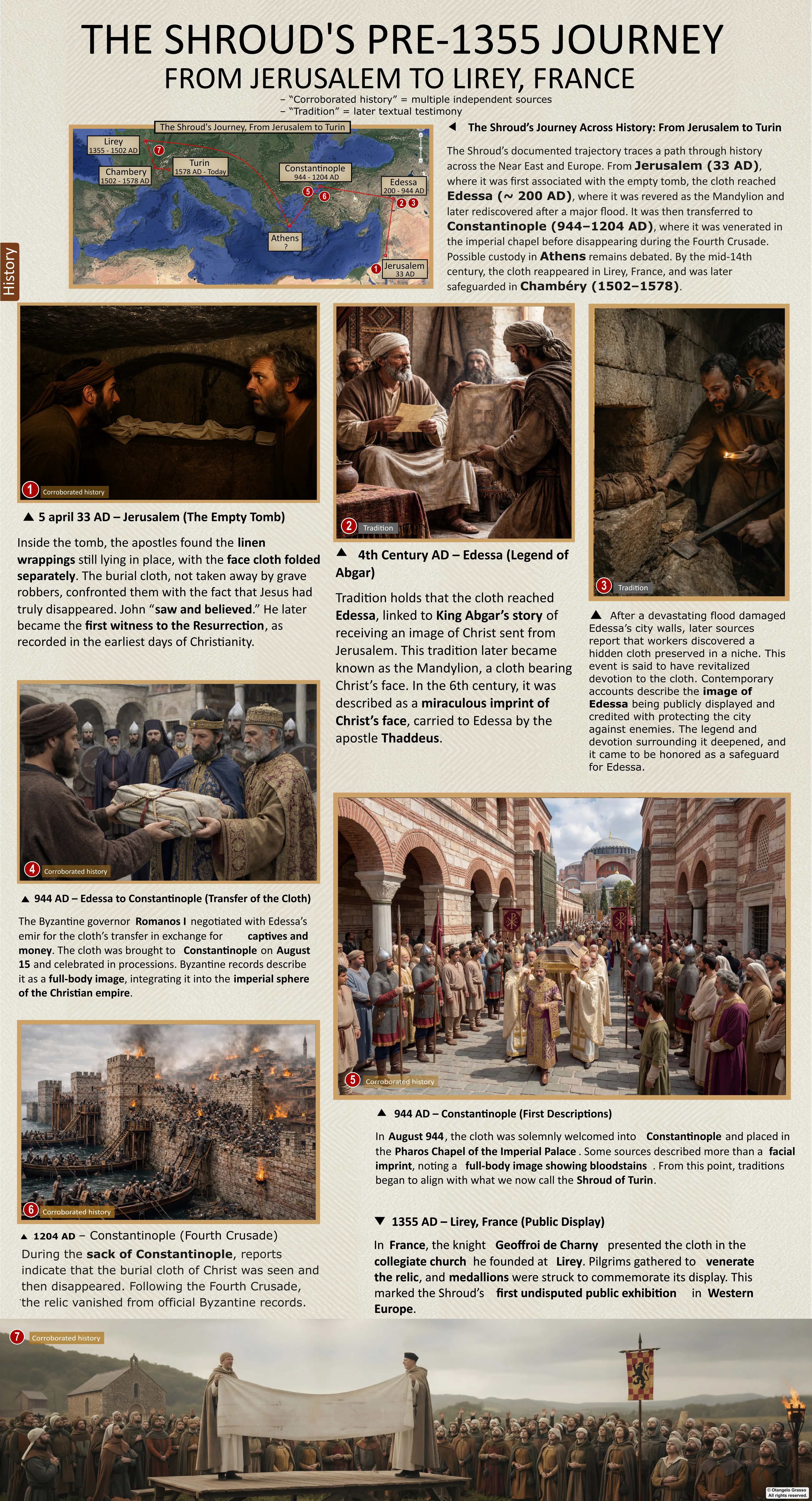
The object and its unfinished biography
A cloth can survive while the record of its movements disappears. A name can survive while the object to which it once referred is lost. The historical problem of the Shroud of Turin lies between those possibilities. There is a surviving textile in Turin, a substantial medieval and modern history of its custody, and a much older body of Christian writing about burial linens and images of Christ. The central question is whether particular earlier references belong to the biography of this particular cloth.
The question cannot be answered by putting every mention of a shroud on one timeline and connecting the dates. Some sources describe burial linens without an image. Others describe a facial image whose origin is placed during Jesus’ lifetime. Others record a transfer, a ceremonial display, or an accusation. Each contributes evidence, but each contributes a different kind. A history of Christian belief in sacred cloths is broader than the history of the Turin object.1, 2, 12, 20
The most influential proposed connection identifies the Shroud with the Image of Edessa, later commonly called the Mandylion. Ian Wilson’s reconstruction explains the apparent difference between a facial image and a double full-body image by proposing a folded display: most of the linen was concealed while the face remained visible. An alternative family of reconstructions, associated particularly with Jack Markwardt, gives Antioch and other Byzantine image traditions a larger role. These proposals deserve examination because they attempt to explain specific texts and material features. Their explanatory appeal does not remove the need to demonstrate the links between their objects.2, 17, 18, 19, 36
This chapter follows the evidence through Jerusalem, Edessa, Constantinople, the uncertain years after 1204, and the documented western history. Its conclusion is deliberately differentiated. The Image of Edessa had a substantial historical cult. Constantinople possessed objects venerated as Christ’s burial linens. The Turin cloth has a securely identifiable western history from the later Middle Ages. Whether those histories converge on one surviving textile remains disputed. An exhaustive investigation has to explain why the connection is attractive, where the evidence resists it, and what would distinguish a successful reconstruction from a compelling story.
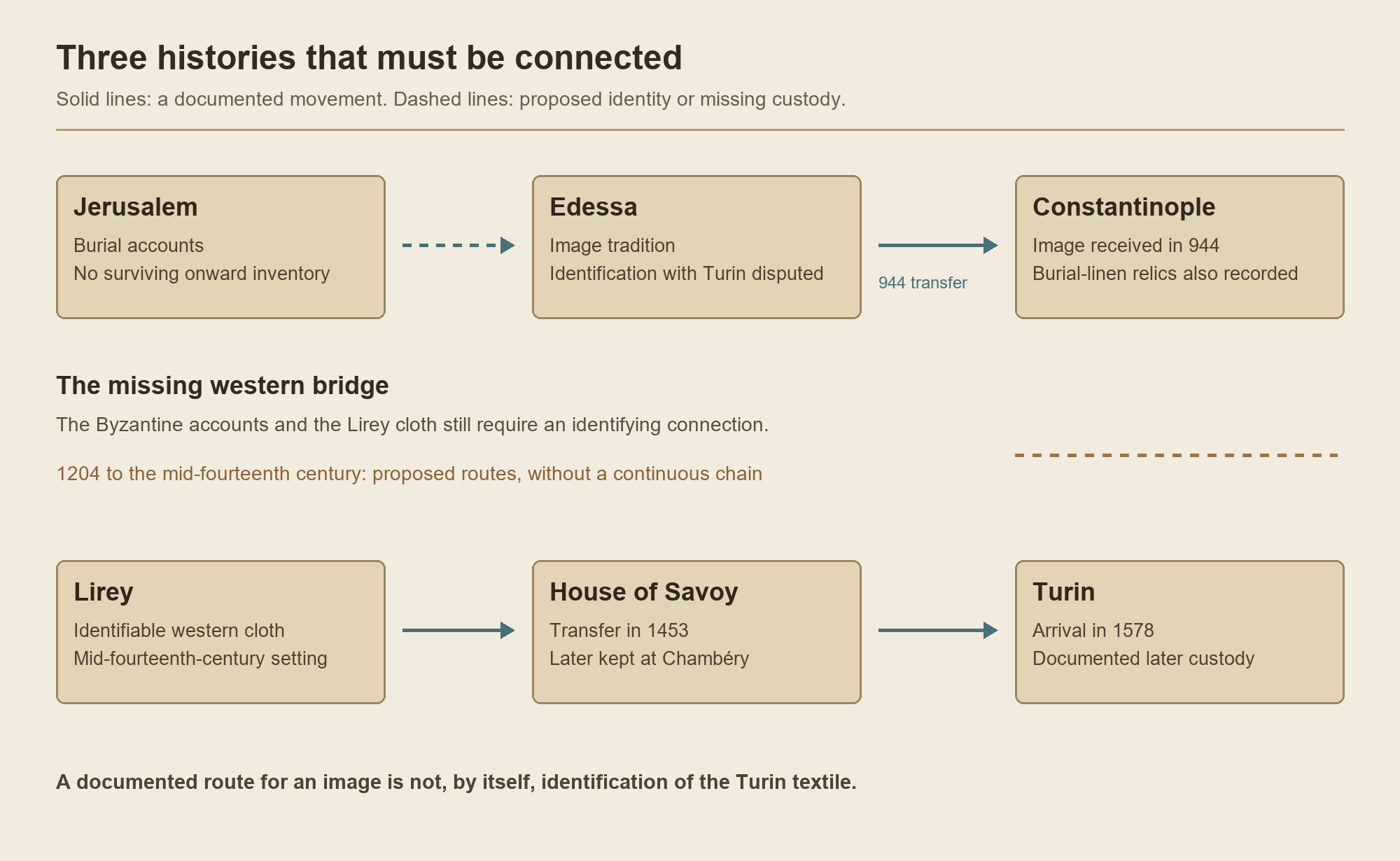
1. What a historical identification must establish
There are at least four propositions in a claim that an ancient source records the Turin Shroud. The source must be genuine enough to use. Its words must refer to a material object rather than merely to a metaphor or a remembered biblical episode. The object must have identifying features relevant to the Turin cloth. Finally, some defensible connection must link the earlier object to the later one. A convincing answer to one proposition does not settle all four.
A record that an image moved from Edessa to Constantinople in 944 can establish a transfer without establishing that the image was the Turin Shroud. A description of burial linens in a Byzantine treasury can establish a relic claim without establishing that the linens bore an image. A picture resembling the Turin figure can establish an artistic comparison without establishing the painter’s access to the cloth. These are distinctions about the reach of evidence, rather than objections to investigating it.2
The useful starting point is therefore a set of questions: what was seen or reported, by whom, at what date, in what genre, and with what identifying details? Dimensions, image orientation, front-and-back presentation, damage, associated inscriptions, named custodians, and documented transfers have different capacities to discriminate among objects. The more widely a description applies to Christian relics in general, the less securely it identifies one relic in particular.
This also explains why a custody gap matters without automatically disproving authenticity. A missing interval makes an identification harder to establish. It does not demonstrate that the object ceased to exist. Conversely, naming a plausible route through that interval does not show that the object traveled it. The investigation must keep both observations in view.
| Evidence type | What it can establish | What it cannot establish alone |
|---|---|---|
| Transfer account | A named object moved between places | That the object was the Turin Shroud |
| Burial-linen notice | A community claimed or venerated burial cloths | A visible double image or a continuous custody chain |
| Lexical expression | How a writer described a textile or image | Exact dimensions or a unique folding diagram |
| Artistic comparison | A motif existed by an artwork’s date | The date of a proposed model without proving dependence |
| Physical fold or damage | Handling, alteration, and sometimes relative sequence | The city, custodian, or year without external evidence |
| Dated analysis | A measurement of identified material under a method | Every earlier step in its ownership history |
2. The four dates inside an ancient reference
An account can involve four distinct dates: the event it describes, the composition of the work, the copying of the surviving manuscript, and the modern recognition of its possible relevance. Confusion among these dates can give a late witness an appearance of immediacy that it does not possess.
An account set in the apostolic period may have been composed centuries later. A medieval copy may preserve a genuinely earlier work. A modern translation may correctly identify an old passage while giving a disputed interpretation of it. None of these situations can be evaluated simply by citing the earliest date appearing in the story.
The separation is particularly important for Edessa. A tradition can place an image in the hands of King Abgar during Jesus’ lifetime, yet its surviving textual development must be studied in the centuries when its versions become attested. The historical existence of an Abgar does not authenticate every episode later attributed to him. Likewise, a tenth-century account of an earlier concealment is evidence that the concealment story existed by the tenth century; demonstrating the concealment itself requires additional argument.4, 6, 9, 12
Manuscript transmission should neither be ignored nor used as an automatic dismissal. Many accepted ancient works survive in substantially later copies. The relevant questions concern the manuscript relationships, textual variants, citations by other writers, and the fit between the work and its historical setting. A late copy does not make an early composition impossible. It does prevent treating the physical manuscript as a contemporary receipt for every event it narrates.
3. Jerusalem: a burial account without a subsequent inventory
The canonical Gospels provide the starting vocabulary: a principal linen sheet in the Synoptic burial accounts, plural linen cloths in John, and a separately mentioned head cloth in John’s empty-tomb narrative. They do not provide an itinerary leading to Edessa, an inventory assigning custody to a named apostle, or a description of the Turin cloth’s double image. Chapter 15 examined what the remaining linens contribute to John’s account. Here the issue is their later history.1
It is reasonable to ask whether followers could have preserved material associated with Jesus’ burial. Preservation is a historical possibility. The reasons often proposed for secrecy—persecution, disputes over sacred objects, ritual concerns, or reluctance to display an image of an executed man—are possible contextual explanations. They are not surviving records of a particular custodial decision.
The temptation is to let a proposed motive do the work of a missing document. Once secrecy is assumed, every silence can appear to confirm it. But an undisclosed object and an absent object can both leave no public record. To distinguish them, the secrecy hypothesis needs some positive connection: a recognizable description, a credible transfer tradition, or a material feature independently tied to an earlier setting.
The gap after the burial accounts must therefore remain visible. It is not a reason to stop the investigation, and it is not a piece of positive proof that a hidden relic existed. It defines the first interval that an ancient-origin reconstruction has to explain.
4. Apocryphal linen, royal garments, and liturgical memory
Jerome’s account of James in On Illustrious Men preserves a fragment attributed to the Gospel according to the Hebrews. It describes Jesus giving a linen cloth to a priest’s servant before appearing to James. The relevant surviving quotation is in Jerome; describing it simply as a quotation preserved by Origen obscures the actual witness. The fragment is relevant to an early post-resurrection linen tradition. It does not describe a double image, specify Edessa, or identify a surviving textile.3
The royal garment in the Hymn of the Pearl, transmitted within the Acts of Thomas, belongs to a different category. A garment bearing a royal likeness can be significant in the history of religious imagery without functioning as an eyewitness description of a burial shroud. Allegorical correspondences do not become geographic provenance merely because an image-bearing garment sounds suggestive. The argument requires a demonstrated relationship between the literary motif and the relic.2
Liturgical references require equally careful treatment. Theodore of Mopsuestia’s account of Eucharistic actions connects altar arrangements with Christ’s burial. Such symbolism shows that burial linens had a place in Christian ritual interpretation. It does not by itself demonstrate that Theodore inspected a cloth bearing a visible body image. The representation can be enacted by the rite rather than displayed on the fabric.
The often-cited Old Hispanic or Mozarabic material also needs its own textual history. A liturgical elaboration on Peter’s sight of the linens is not a new verse of John. Before using words translated as traces or impressions as evidence of an image-bearing relic, one must establish the manuscript, the Latin wording, the translation, and the date of that textual layer. A rite’s ancient roots do not automatically date every surviving phrase to its earliest phase.
These sources establish a substantial field of Christian memory about burial cloths. They keep the historical inquiry open. They do not supply an unbroken chain connecting the tomb with Turin, and they should not be made to carry that burden.2
5. Eusebius and the Abgar correspondence
Eusebius, writing in the early fourth century, relates an exchange between Jesus and Abgar of Edessa and the subsequent mission of Thaddaeus. He says that he obtained the correspondence from Edessa’s archives and translated it from Syriac. His account contains letters, healing, apostolic preaching, and a vision associated with Thaddaeus. It does not describe a portrait carried on a cloth.4
That omission is important because it occurs within a detailed presentation of the very story later used to explain Edessa’s image. It does not prove that no image existed anywhere in Edessa. It does show that the image is not part of the account Eusebius actually gives. A reconstruction should explain this development rather than silently inserting the later object into his narrative.
Eusebius’s confidence in his archive also needs historical evaluation. An ancient writer’s report that an archive contained a document establishes his claim and his use of the material. It does not independently authenticate a first-century letter from Jesus. The correspondence’s authority within Christian tradition and its authenticity as first-century correspondence are separate questions.
The proper conclusion is narrower than either extreme. Eusebius is a major witness to the early circulation of the Abgar tradition. He is not a witness to a double-image shroud in Edessa. Later developments must be read alongside his version, with their additions and differences left visible.
6. Egeria, Addai, and the emergence of a portrait
Egeria’s late-fourth-century pilgrimage account describes an Edessan visit centered on Abgar’s memory and the protective letter attributed to Jesus. The bishop shows her sites and reads the correspondence. In the surviving account she does not describe being shown an image of Christ.5
This is a contextual silence, not a universal declaration that the city possessed no image. Egeria did not write an exhaustive inventory. Nevertheless, an argument that an immensely important, openly venerated Christ-image was already central to the city must explain why this interested visitor’s account instead emphasizes the letter. The force of the silence depends on what she was likely to encounter and report.
The Doctrine of Addai contains an unmistakable portrait episode. Hannan, associated with Abgar’s mission, paints Jesus’ likeness with paints and brings it to the king. The work therefore witnesses a portrait tradition, but the portrait described is painted. It is not presented as the unpainted double impression of a dead body.6
The contrast between these accounts matters more than a simple accumulation of names. Eusebius’s correspondence, Egeria’s letter-centered visit, and Addai’s painted portrait are not three independent descriptions of the same full-length cloth. They are stages and variants in a developing tradition. They may preserve historical memories, literary elaboration, or both. Determining the relationship among them is the work of textual history; assuming their identity at the outset would decide the central question before examining it.
7. The siege of 544 and Evagrius’s later account
The Persian siege of Edessa provides one of the most important landmarks. Procopius discusses the city’s protection tradition and gives a detailed military account of the siege, including efforts against a siege mound. Evagrius, writing later in the sixth century, recounts the siege and introduces an image associated with divine manufacture and the city’s deliverance.7, 8
Evagrius is therefore substantial evidence that a miraculous-image tradition was established by his period of writing. His description should not be expanded into every feature of the later concealment legend. In particular, his siege account must not simply be reported as an eyewitness discovery of a forgotten image in a niche over the city gate. The wall-concealment and rediscovery narrative belongs to the larger, developing Edessa dossier.8, 12
The interval between the event and its narration matters. A later account can preserve genuine earlier information; it can also reshape an event through the community’s devotional understanding. The difference between Procopius and Evagrius raises a historical question about the image tradition’s growth. It does not license the assumption that one must be consciously falsifying the other.
What this landmark establishes is a late-antique Edessan image tradition connected with civic protection. What it leaves unresolved is the object’s physical extent, the date of its manufacture, and its identity with the Turin linen. Calling 544 a documented appearance of the Turin Shroud skips those intermediate questions.
8. What “not made by human hands” establishes
Acheiropoietos expresses an attribution of origin. It tells us that an image was understood as coming about without ordinary human manufacture. In Christian image traditions, this claim could ground the image’s authority and its relationship to Christ. It does not constitute a laboratory finding about a surviving object’s pigments, fibers, or chemistry.12, 16
This distinction prevents a circular identification. The Turin image is unusual, and its complete formation remains disputed. A Byzantine source calls an image miraculous. Those two facts do not, by themselves, establish that the source and the modern examination concern the same material object. Many objects can be credited with extraordinary origins, and more than one image tradition can employ the same theological language.
There is nevertheless a legitimate connection to investigate. Traditions of direct bodily contact can shape the way an image is described, displayed, and copied. If a source also provides unusual dimensions, a recognizable damage pattern, or a reliable custody link, its claim of direct contact becomes part of a more specific identification. Without those additions, the word primarily locates the image within a religious category.
An exhaustive history should therefore ask how the language functioned before asking whether modern science confirms it. Did it defend the legitimacy of images? Explain a faint likeness? Establish the authority of a city’s relic? Distinguish an original from its copies? The answer can reveal a great deal about the image’s historical role while leaving its identity with Turin unsettled.
9. The Acts of Thaddaeus and tetradiplon
The Greek Acts of Thaddaeus describes a miraculous facial impression on a cloth given to Abgar’s messenger. Its dating and manuscript history require care; it should not be treated as a first-century deposition merely because its story is set in the apostolic age. The cloth episode supplies a particularly important term, tetradiplon, which has become central to the folding argument.9, 10
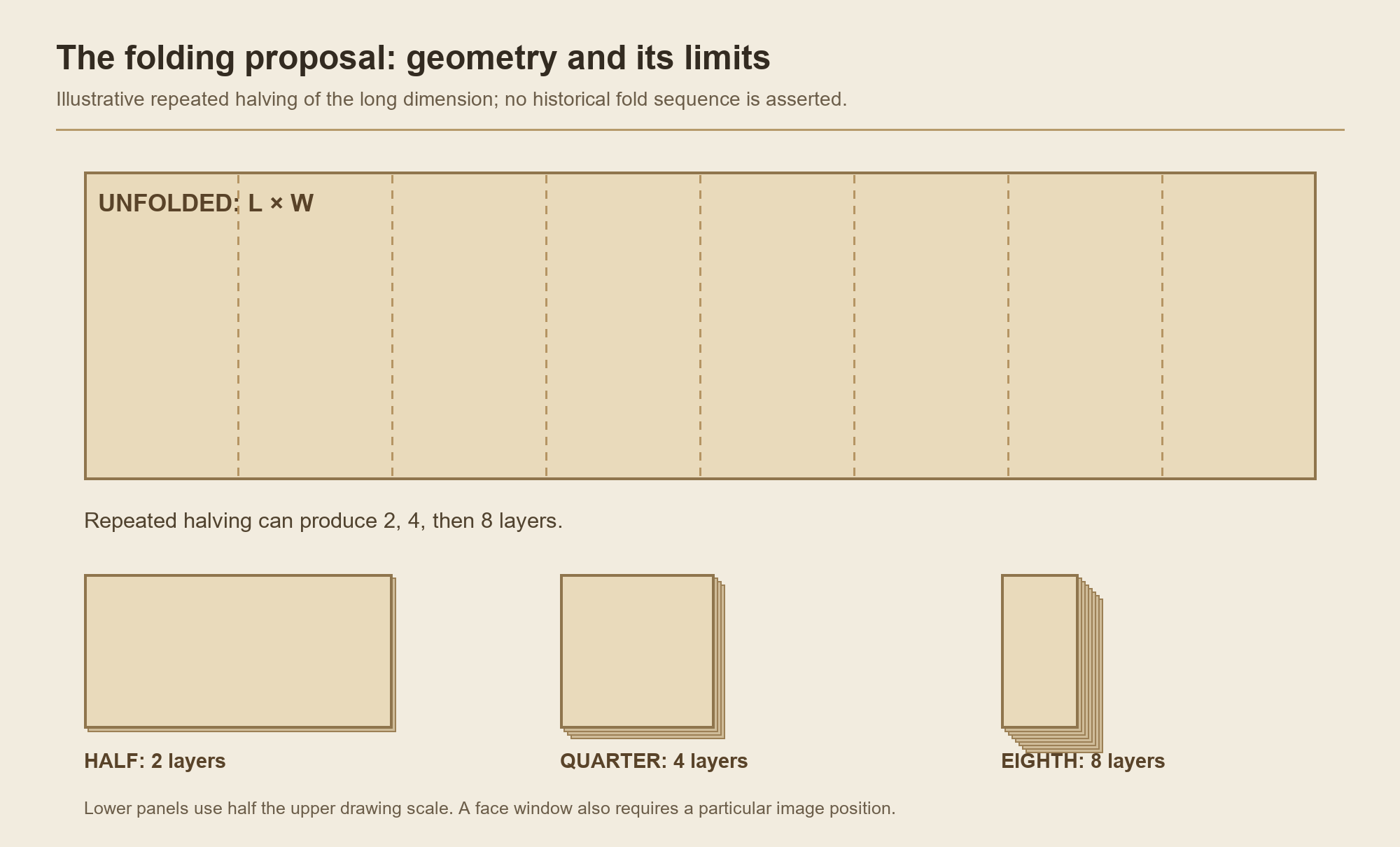
Wilson’s interpretation associates the term with repeated doubling that produces an eight-layer packet. Such a configuration can be constructed from a longer sheet and can leave a face visible on an outer panel. This is a meaningful geometrical proposal. The word alone does not provide the unfolded cloth’s dimensions, an orientation diagram, a count of all its image-bearing surfaces, or the location of the Turin face within the proposed folds.2, 17
Lexical precision matters here. The term occurs in the Acts dossier; it should not be casually attributed to the tenth-century Narratio as though the two works were interchangeable. Nor should its rarity be inflated into a claim that its exact physical meaning is beyond dispute. A rare expression offers fewer comparative examples, which can increase rather than eliminate interpretive uncertainty.10, 12
The strongest argument is consequently cumulative and testable: the proposed meaning should fit the Greek context, the display geometry should fit the actual image positions, and any surviving folds should be independently compatible. That is a better argument than translating a compound word directly into the proposition that the Turin Shroud was in Edessa.
10. Folding a cloth is not dating a fold
The folding model solves a real presentational problem. A long sheet does not have to be displayed at its full extent. A face-centered arrangement can make an object appear to an observer as a facial icon. The model therefore answers an objection based simply on the difference between face-only presentation and full-length cloth.
It does not yet establish that this presentation occurred in Edessa. A compatible fold can be imposed at many dates and places. A crease can record handling without preserving a readable label identifying the custodian who made it. A pattern interrupted by later damage may support relative chronology, but moving from “earlier than this damage” to “present in Edessa before 944” requires another connection.2
The smaller repeated burn-hole groups raise a related issue. Their pattern can be compared with folded layers, and they are distinct from the major paired damage associated with the Chambéry fire. The 1516 Lier copy provides an important pre-1532 comparison. A claim that the Pray illumination records the same holes would, if established, provide a much earlier limit. But the meaning of those painted marks is precisely what is debated; it cannot be assumed when using the manuscript to date the damage.23, 28, 29
An informative study would publish calibrated crease locations, measurement uncertainties, alternative folding solutions, and the effect of repairs and mounting. A model should predict features not used to construct it. If several configurations fit equally well, the evidence supports folding more securely than one historical folding regime. Material compatibility is valuable; temporal and geographic specificity must be earned separately.
11. John of Damascus and the iconoclasm argument
John of Damascus invokes the Abgar image in a defense of sacred images. In the tradition he recounts, Jesus places a garment against his face and sends the resulting likeness to Abgar. This is direct evidence that Edessa’s image tradition could circulate in theological discussion beyond the city itself.11
The passage qualifies an argument sometimes made for Wilson’s route: that Edessa’s position outside Byzantine imperial control explains the image’s total absence from image debates. Political separation could affect physical access and exposure to imperial destruction. It did not prevent news, traditions, and theological arguments from crossing borders. The tradition was not simply unavailable to image defenders.
Himation, a garment word in this discussion, also requires contextual restraint. A garment can be large enough to receive more than a face. Its name does not fix an exact length and width or establish that it already bore a full body. Conversely, translating it as a garment does show why it is unwise to imagine that every facial-image narrative necessarily describes a rigidly standardized handkerchief.10, 11
Geopolitical context thus remains relevant without becoming decisive. A model placing a relic outside the empire during iconoclasm may explain survival. A model placing it inside needs to address its treatment and visibility. Neither location follows simply from silence. The question is which reconstruction explains the actual distribution of references with the fewest unsupported additions, including references that do survive.
12. The transfer of 944: a firm event with a disputed identification
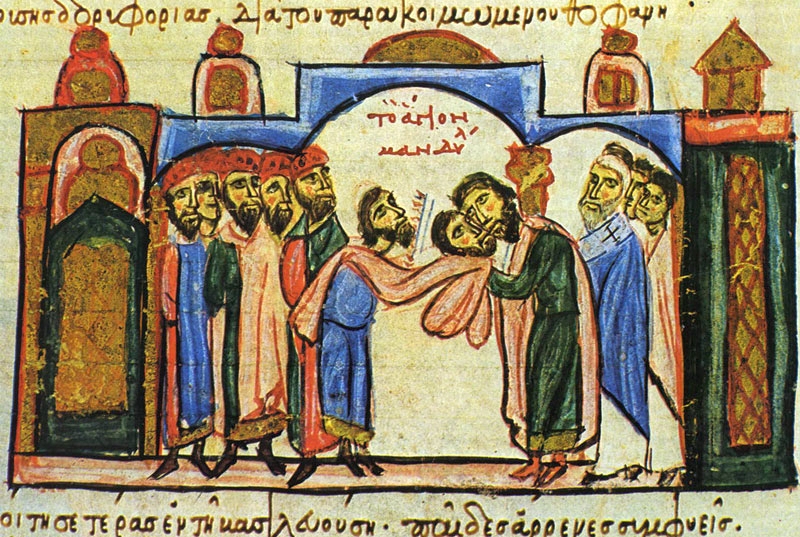
The ceremonial transfer of Edessa’s image to Constantinople in 944 is a much firmer historical landmark than the apostolic route proposed for it. The image entered an imperial setting in which relics, sacred images, political legitimacy, and public worship were closely connected. The reception and its associated literature established a durable place for the Edessan object in Byzantine religious memory.12, 13, 14
The distinction between transfer and identity is decisive. The event provides a route for an Edessan image. Identifying it with Turin requires an additional argument about the thing transferred. One should not describe the ceremony as a documented arrival of the full Turin double image unless that separate identification has been established.
The Narratio de imagine Edessena is an essential part of the reception dossier. It is associated with Constantine VII’s court and preserves an extended account of the image’s origins and movement. It combines a history of the acquisition with inherited origin traditions. Proximity to the tenth-century transfer does not give every episode in its earlier narrative the same contemporary evidentiary status.12
The public celebration is important in its own right. It shows the value assigned to the object and the institutional setting in which descriptions and copies could spread. An authentic transfer can involve a legendary account of origin. Recognizing that combination preserves the historical event while leaving room to investigate the authority attached to it.
13. Gregory Referendarius and the corrected side-wound reading
Gregory’s reception homily is frequently presented as the moment when a Byzantine observer disclosed blood from a side wound on the image. That presentation cannot ignore the subsequent correction by Mark Guscin, whose English translation helped popularize the reading. In an addendum dated December 2007 and posted in 2008, Guscin concluded that the relevant Greek and the internal logic did not support his earlier interpretation.13, 14, 15
The corrected reading distinguishes two events: the sweat associated with the facial image and the blood associated with Christ’s body and side. The homily should therefore not be cited as an unequivocal eyewitness description of a lance-wound stain on the Edessa cloth. The correction concerns this argument, rather than constituting a withdrawal of every possible connection between Edessa and Turin.15
The episode illustrates why translations need a history. A forceful statement in an earlier paper can remain in circulation long after its translator has revised it. Quoting the earlier conclusion without the addendum makes a disputed reading look settled. Conversely, acknowledging the correction does not erase the homily’s value as evidence for the reception and interpretation of the image.
What survives is a substantial witness to the image’s theological meaning and its place in the ceremonial world of 944. What does not survive, on this basis alone, is a securely observed full-body image with a visible side wound. The argument for a larger cloth must rest on other evidence.
14. Full-body language and the problem of textual variants
Some versions of the Edessa tradition contain language interpreted as referring to Christ’s full bodily likeness, bodily extent, or an image on a larger textile. The Vossianus and Tarragona materials, together with later liturgical and narrative variants, are repeatedly invoked in this connection. They deserve individual examination rather than dismissal by a general definition of Mandylion.2, 12, 17
They also cannot be compressed into a single imperial eyewitness statement. A claim that Constantine VII personally inspected and measured a full-length double image requires the specific passage that says so. A text produced under imperial auspices, a later manuscript transmitting a variant, and an emperor’s separate reference to a God-bearing shroud are different witnesses. Their connection must be demonstrated, not supplied by the modern narrative.
The critical questions are concrete. Does the passage describe what a viewer saw, what Abgar requested, or what the author understood the image to mean? Does “whole” qualify a figure, a likeness, the fabric, or the completeness of representation? Is the wording shared by independent manuscripts or restricted to one branch of the tradition? Can the date of that reading be established?
The point is not to prohibit a full-body interpretation. It is to identify the burden it carries. A demonstrably early, unambiguous description of a long sheet bearing front and back would be strongly identifying. A late or ambiguous description has less discriminatory force. Both belong in a source catalogue, but their evidentiary weights should remain different.
15. Two sanctuaries, two settings: Pharos and Blachernae
The Constantinople evidence must first be put on a city plan. The Theotokos tou Pharou, usually called the Church of the Virgin of the Pharos, belonged to the Great Palace complex toward the city's southeastern seaward side. Its name referred to the lighthouse. Saint Mary of Blachernae belonged to a different sanctuary complex in the northwestern part of the city, associated with the Blachernae imperial residence. They were not alternative names for one chapel. A witness placing an object in the palace treasury has not thereby placed it in the Blachernae church.37, 40
That distinction is particularly important because both churches were dedicated to the Mother of God. Theotokos names the dedication, not a unique building. A modern reference merely to the Church of the Virgin can therefore erase the very information needed to distinguish two sources. Boukoleon or Bucoleon, meanwhile, identifies the southern palace setting in western descriptions; it should not be silently substituted for the northern Blachernae palace. The Great Palace also contained other churches. Even a correct palace identification does not automatically identify the particular room or treasury.
The appropriate reconstruction starts with separate entries: the Edessan facial image associated with the Pharos collection; the burial linens described by the Pharos custodian; and the burial cloth Robert de Clari places at Blachernae. They may ultimately prove connected. Keeping them separate initially allows that connection to be tested. Merging them before examining the sources would make a proposed journey across the city disappear into a change of name.
This approach does not diminish the Byzantine evidence. It reveals its real strength: several kinds of witness, speaking from different settings, describe sacred textiles before the recognizable western history of the Turin cloth. The historical task is to determine how much of that evidence concerns one object, how much concerns a collection, and how much concerns a ceremonial interpretation.
16. The Theotokos of the Pharos before the arrival from Edessa
The Pharos was an established imperial church before 944. Holger Klein's reconstruction identifies an early literary notice in connection with Irene's marriage arrangements and a major rebuilding and redecoration under Michael III, associated with the rededication of 864. By the tenth century it had become a principal palace repository for important Christian relics. Its history was therefore not created by the arrival of the Mandylion.37
The setting matters to the interpretation of an inventory. The palace church could gather objects associated with different moments in Christ's life. A list of those objects expressed both custody and the sacred significance of the emperor's capital. This was an institutional collection, not a sealed assemblage from a single burial. Its contents should not be read as though each listed cloth had entered the treasury together with every other Passion relic.
Mesarites later presents the church as bringing the geography of salvation into one place. His description evokes the biblical settings of Christ's ministry, Passion, burial, and resurrection. Relics could enable the worshipper to contemplate distant events as spiritually present. That helps explain why his prose moves between the object before him and the event it commemorates. It does not entitle a modern reader to convert every vivid sentence into an account of a visible image on linen.38
The difference can be stated precisely. A church can be described as another Jerusalem because it houses Passion relics. It need not contain a topographically exact representation of Jerusalem. Likewise, burial textiles can be called witnesses of resurrection because they are understood as the abandoned linens of the tomb. That language is meaningful evidence of their veneration. Whether a particular textile displayed the bodily image now seen at Turin remains an additional question.
17. From the reception of 944 to an expanding imperial collection
The Edessan image's reception in August 944 supplies a secure institutional landmark. The ceremonial accounts and Gregory's homily belong to that reception, while the Pharos became its imperial repository. The distinction between the arrival celebrations and subsequent custody is useful: passing through a ceremonial location does not establish that the image was permanently stored in every church associated with its reception.12, 13, 37
The collection continued to change. Klein traces the arrival of the Holy Keramion in 968 and the addition of the letter attributed to Jesus and addressed to Abgar in 1032. Consequently, the cloth-image and every other Abgar-associated object should not be assumed to have entered the capital in a single shipment in 944. The later collection assembled a sacred narrative through acquisitions made at different times.37
This history also explains why the tile must remain distinct from the textile. The Keramion's significance depended on its relationship to the image tradition, but a tile was not another fold of a shroud. A text naming both image-bearing objects is describing an associated group. The same reasoning must be applied when the text additionally names burial linens: association within a collection is not, by itself, identity of material objects.
For the proposed Shroud identification, 944 establishes the movement of an image from Edessa to Constantinople. A successful identification with Turin would connect that transfer with a sufficiently particular description of the textile. The court setting, the object's authority, and its later fame strengthen the historical context. They cannot substitute for the missing physical descriptors. Nor does the arrival date establish that every burial-linen reference appearing after 944 describes the newly arrived Edessan image.
18. Constantine VII's military address of 958
The military address associated with Constantine VII in 958 is an important witness to burial relics in the capital. The emperor describes sending sanctified water to the troops after contact with Passion relics. The list includes sacred wrappings and a God-bearing sindon. Its importance does not depend on treating the adjective as a technical description of an image.39, 40
The designation God-bearing is intelligible of a cloth believed to have enclosed Christ's body. It need not mean bearing a visible portrait of God. Similarly, the presence of a separately named relic of blood from Christ's side does not state that the blood lay on the sindon. A list can include blood, a garment, and burial textiles as different items. Moving the blood from its listed relic to a stain on the cloth would introduce a physical relationship the passage has not supplied.
The address nevertheless contributes something substantial. An imperial voice invokes a shroud within the Passion-relic environment fourteen years after the Edessa reception. That is stronger than a modern conjecture that Byzantine Christians might have possessed burial cloths. It establishes the claim within an identifiable court context. It does not provide measurements, a weave description, front-and-back image details, or an account of the cloth's arrival.
The silence about a separate arrival has inspired an argument for identity with the Mandylion: if no second arrival is recorded, perhaps the two names refer to one object. That is a possible inference, not a deduction. The survival of ceremonial accounts is uneven, and an existing collection could include items acquired in ways no longer documented. Conversely, the presence of different names does not automatically prove two objects in every passage. The question is whether the particular wording coordinates distinct relics, equates them, or leaves their relationship unstated.
19. The eleventh and twelfth centuries: a dossier of visitors and lists
The intervening period should not be reduced to an arrow between 958 and 1201. Scavone's documentary dossier collects the purported letter of Alexios I to Robert of Flanders, an English pilgrim account around 1150, an Icelandic itinerary associated with Nicholas, William of Tyre's account of the 1171 royal visit, and Anthony of Novgorod around 1200. These are different texts with different problems of date, translation, and access.39
The Alexios letter requires a conspicuous qualification: it is not a securely authenticated imperial inventory. Klein treats the purported letter as spurious. Its relic language can enter the history of western representations of Constantinople, but it should not be used as an uncontested administrative statement issued by Alexios. An authentic underlying request and a surviving Latin literary form would still need to be distinguished.37
The pilgrim and visit accounts matter because their textile vocabulary does not always collapse into one object. The English account distinguishes a facial-image cloth from a head cloth; the Icelandic material and the 1171 account add burial-textile testimony. Anthony's list likewise distinguishes cloth descriptions. The English and Icelandic witnesses must also remain separate: their dates and translated inventories are sometimes combined in modern summaries. Here they are treated through the cited editions and discussions, without presenting their Latin translations as the original vernacular wording.39
Their collective significance is continuity of a differentiated relic environment, rather than a sequence of independently verified inspections of the Turin Shroud. A visitor could see a reliquary, hear its identity explained, and record that explanation without opening it. A list might repeat established liturgical names. Another visitor might inspect something more directly. Each account needs an access statement: what was seen, what was named, and what was reported by a guide.
These differences prevent two opposite mistakes. The witnesses should not be dismissed because they were pilgrims rather than modern analysts. Nor should a succession of relic names become a succession of authenticated views of one double-image linen. The dossier is positive evidence for Byzantine possession and veneration of objects represented as Christ's cloths. The finer identification depends on the particularities of each report.
20. Nicholas Mesarites and the defense of the Pharos treasury
Mesarites is a particularly important witness because he served as the Pharos skeuophylax, the keeper responsible for its sacred vessels and treasures. His account of the short-lived usurpation of John Komnenos the Fat, conventionally placed in 1201, situates the relic description within the defense of a threatened imperial sanctuary. Some publications date the episode around 1200; the small chronological difference should not be used to manufacture two separate inspections.38, 41
His catalogue includes burial linens and also the image-bearing towel and tile. This is the point at which the existence of several textile traditions becomes especially difficult to ignore. The custodian is not simply alternating casual names for one object in different books. The account sets different sacred objects within a single rhetorical presentation of a collection.38, 39
The burial-linen passage emphasizes linen material, modest cost, preservation, fragrance, and the body wrapped after the Passion. It provides a detailed description of the cloths' claimed association. It does not plainly describe a dorsal image paired with a frontal image. The distinction should remain visible even when the passage is read favorably toward the possibility of an ancient shroud in the treasury.
The nearby towel description does explicitly invoke an image. That difference gives the text unusual value. Mesarites knew how to speak about an image when he intended to do so. A historical argument identifying his burial linens with the imaged towel must therefore explain his separate treatment, rather than rely on the general proposition that Byzantine terminology was variable.
His position also gives the testimony a particular limit. Custodial knowledge strengthens identification within the institution: this is what the Pharos guarded and called its relics. It does not independently verify every traditional claim about the objects' origins. A custodian's confident belief that a cloth wrapped Christ and a modern proof that the surviving Turin textile is that cloth remain distinct achievements.
21. What Mesarites's theological language does and does not describe
The phrase about the naked body has often carried more weight in modern Shroud arguments than its grammar warrants. A cloth wrapping a naked body is not the same proposition as a cloth visibly depicting that body. The first describes burial; the second describes an image. The latter cannot be obtained merely by transferring an adjective from the deceased to a supposed representation.
The word translated as uncircumscribed or uncontainable creates another interpretive temptation. Within Christian theology, the contrast between divine immensity and bodily enclosure is intelligible without an optical observation. Reading the word as an absence of a drawn outline is a proposed image interpretation, not the only ordinary meaning available in the passage's religious setting. Scavone explores the image inference, but also records the theological alternative.39
The same care applies to fragrance and preservation. These claims tell us how Mesarites celebrates the relics. They do not establish a measured myrrh concentration or a verified chemical inhibition of decay. The description should be quoted or paraphrased as his testimony, not translated into a laboratory finding that he did not make.
None of these qualifications makes the passage empty. Its strongest historical contribution is substantial: a responsible palace official describes linen burial relics before 1204, within a collection that also includes a miraculous Christ-image tradition. That context makes comparison with Robert de Clari necessary. What it does not supply is the identifying bridge between a particular Pharos textile and the particular Blachernae display.
The proper comparison therefore preserves both agreement and difference. Both accounts concern cloths associated with Christ. Both belong to Constantinople near the Fourth Crusade. One is a custodian's rhetorical defense of the Pharos treasury; the other is a western participant's report about another church. Their shared subject makes convergence possible. Their different locations and descriptions make independent examination indispensable.
22. Saint Mary of Blachernae: the basilica, the Soros, and the Marian setting
Blachernae was a sanctuary complex, not merely a room in the Pharos treasury. The basilica and the smaller relic chapel known as the Hagia Soros belonged to a renowned Marian cult. Their association with the Virgin's relics and images supplies the immediate religious context in which Robert's report must be read. The shared dedication to the Theotokos must not obscure their separation from the southern palace chapel.40
Three categories require distinction here. A garment venerated as belonging to the Virgin is a relic. An icon representing her is an image. A textile hung before an icon is a furnishing or veil used in its presentation. Those objects can interact in worship without being physically identical. A modern author who calls all three the veil of Blachernae risks assigning a miracle associated with one category to a surviving object in another.
The distinction also bears on a claim sometimes made about the imperial residence: because the court used Blachernae, the most important southern palace relics must have been moved there. A residence change can make movement plausible. It is not an inventory or transfer record. The Pharos treasury continued to appear in the testimony near 1204; it did not cease to exist simply because another palace mattered politically.
Blachernae is therefore not an incidental place name in the Shroud debate. It is the setting that makes Robert's testimony both unusually interesting and unusually difficult. A burial cloth displaying Christ's form there would be important evidence for a pre-1204 body-image tradition. A description reshaped by the sanctuary's established Marian ceremony would have a different historical meaning. The local cult must be investigated before either conclusion is treated as inevitable.
23. The Friday miracle: Psellos and the lifting of an icon's veil
Michael Psellos provides an independent account of a Friday phenomenon at Blachernae, long before Robert de Clari. In Elizabeth Fisher's translation, his discourse describes the ritual setting around an icon of the Virgin. The central object lifted is a drapery before the icon; the image revealed is Marian. The discourse belongs to the eleventh century and must not be recast as a direct report about the Turin Shroud.42
The relevant contrast with Robert is concrete. Both reports involve Blachernae, Friday, an elevation, and a sacred form made visible. They differ in what is being displayed and how the cloth relates to the image. In Psellos, the veil's movement reveals an icon. In Robert's wording, the visible form of the Lord is associated with the burial cloth itself. This is a meaningful parallel, but it is not a verbatim agreement identifying one ritual object.
Nicolotti's 2011 study proposes that Robert's report reflects a confused understanding of the established Marian miracle. This is a serious alternative explanation because it appeals to an independently documented ceremony at the named sanctuary. Its difficulty is equally clear: it must account for Robert's explicit identification of a cloth in which Christ had been wrapped. Merely noting that both reports mention Friday does not explain that change of identity.40
A defender of a separate burial-cloth display has a corresponding burden. The existence of the Marian rite does not prohibit a different rite in the same complex, but a second regular exhibition should be supported where possible by another witness, an inventory, a liturgical instruction, or an account of the relevant object. The most defensible assessment keeps the alternative explanations side by side. A documented Marian veil ceremony makes confusion possible; Robert's burial language prevents that explanation from being assumed without argument.
24. Robert de Clari's burial cloth at Blachernae
Robert's report in chapter 92 names Saint Mary of Blachernae, identifies a cloth associated with Christ's wrapping, describes its Friday elevation, and connects that elevation with the visibility of the Lord's form. The English version hosted by De Re Militari says that the cloth rose so that "the form of Our Lord could clearly be seen." Those words warrant sustained attention because the report brings burial association and visible form together.22
The quoted English wording should not conceal the philological problem. Robert's Old French uses sydoines and figure, together with a reflexive expression commonly rendered as rose or raised itself upright. The translation form avoids prematurely deciding whether figure means face alone or an entire bodily presentation. The account does not specify Turin's double image, the number of images, the textile's dimensions, or its weave.22, 40
The temporal language likewise needs discipline. Robert describes a recurring Friday display. Replacing it with a once-yearly Good Friday ceremony is a reinterpretation requiring justification. Equally, the text does not describe a measured lifting device, a cylinder, a particular chest, or a sequence of unfolding panels. Reconstructions of such equipment can explore feasibility, but their illustrations must not be presented as documentary views of the original exhibition.
The source also leaves the degree of direct observation uncertain. Participation in the crusade establishes Robert's presence in the relevant world; it does not prove that he personally attended every event he records. His wording preserves a report about what was kept and displayed there. It should not be inflated into a statement that he inspected both sides at close range. Nor should uncertainty about attendance be turned into a reason to discard the testimony altogether.
Its best-supported significance remains striking. A participant's chronicle preserves a pre-conquest claim about an image-associated burial cloth at a named Constantinopolitan sanctuary. That is more specific than a generic reference to sacred linen. It remains less specific than an identification of the Turin textile.
25. The same chronicler's separate account of the towel and tile
Robert's account of the southern palace's sacred treasures is essential to the comparison. Elsewhere in his chronicle he reports cases associated with a towel bearing Christ's facial likeness and a tile connected with the same image tradition. Scavone's dossier explicitly distinguishes these palace reports from chapter 92's Blachernae cloth.39
That distinction places a limit on a simple equation: Robert mentioned a burial cloth, therefore he must have been describing the Mandylion. The same writer knew a separate towel-and-tile tradition in a different setting. An identity hypothesis must explain why those palace objects and the Blachernae cloth appear separately. The possibility of movement or multiple descriptions remains open, but it is the conclusion to establish.
The cases also matter to access. Seeing a richly mounted container and hearing its contents explained is different from seeing the textile spread out. A suspended reliquary is not evidence for the size of the cloth concealed within it. Nor can the cloth's size be inferred simply from the case's religious importance. What a witness inspected and what the witness was told must remain separate entries in the historical record.
An object may also retain an old name after a reinterpretation. That possibility gives an identity proposal room to work; it does not automatically solve the problem of simultaneous entries. If one text appears to locate an imaged towel at the palace and a burial cloth at Blachernae, the proposal needs to address chronology, access, and the exact relationship between the reports. The reader should be shown that problem rather than given a seamless account in which the distinction has disappeared.
The strongest reading at this stage is consequently a deliberately limited one: Robert's chronicle preserves more than one sacred-cloth report. Its internal distinctions are evidence. They should be evaluated before modern researchers decide how many physical objects stood behind them.
26. Was a burial cloth moved from the Pharos to Blachernae?
A movement between the churches is one possible explanation of the apparent convergence between Mesarites and Robert. The interval between the palace crisis around 1201 and the crusader presence in 1203 allows time for relocation. The imperial residence, the security situation, or a special ceremonial purpose could each have provided a motive. Scavone explicitly proposes movement as a possibility; he does not produce a surviving dispatch identifying the transferred cloth.39
The hypothesis should be divided into three propositions. First, an object could physically have moved between two churches in the same city. Second, officials might have had a reason to move it. Third, the specific Pharos burial linen was in fact the specific Blachernae cloth Robert describes. The first is easy to accept; the second is historically plausible; the third requires identifying evidence. Treating the first two as proof of the third hides the principal historical problem.
An emergency relocation is not the only possibility. There could have been a regular ceremonial transfer, a permanent earlier move, two different burial-cloth claims, a liturgical representation, or a misunderstanding of the Marian ceremony. A reconstruction should compare those possibilities using the same standards rather than demand receipts from one while accepting motives as documentation for another.
The strongest evidence for a transfer would name the object, its original repository, its destination, and the occasion. A source describing distinctive dimensions or damage at both locations could also provide a material bridge. In the material examined here, that bridge has not been established. A proposed transfer may make the narrative coherent, but coherence is the starting point for testing a provenance, not its completion.
This leaves a positive result rather than a dead end. Constantinople possessed a burial-linen tradition securely situated in the imperial treasury and a remarkable burial-cloth report situated at Blachernae. Their relationship is a defined research question. The gap is narrower and more concrete than a vague claim that nothing is known before Lirey, but it is still a gap.
27. The Constantinople chronology and the kind of evidence at each date
The chronological sequence is most useful when it preserves what each witness actually establishes. It should not be titled a documented itinerary of the Turin Shroud, because that would assume the identity being investigated. The sequence below distinguishes the churches, the reported objects, and the additional connection needed to reach Turin.12, 22, 37, 39, 40, 42
| Date and witness | Setting and reported evidence | Limit on identification |
|---|---|---|
| Before 944; Pharos history | Established palace church, rebuilt under Michael III; an existing imperial sacred setting | The church's age does not date a particular textile |
| 944; reception dossier | The Edessan image enters the capital and the Pharos collection | Transfer of an image is not yet identification with Turin |
| 958; Constantine VII | Passion-relic list includes sacred wrappings and a God-bearing sindon | No double-image description or explicit equation with the Mandylion |
| 968 and 1032; later acquisitions | Keramion and Abgar letter enter the developing collection at different dates | Associated traditions do not imply one simultaneous arrival |
| 1075; Psellos | Marian icon and lifting drapery at Blachernae | A different object-function from an imaged burial cloth |
| Around 1150; English pilgrim | Distinct facial-image and head-cloth references | Reported identities do not establish access to all contents |
| 1150s; Icelandic itinerary | Additional Passion-textile testimony in translated accounts | Keep itinerary, date, original wording, and later translation distinct |
| 1171; William of Tyre | Royal visit and a syndon in the imperial relic environment | Naming a shroud does not describe Turin's paired images |
| Around 1200; Anthony of Novgorod | Differentiated cloth entries in the relic dossier | Do not merge every textile into one object |
| 1200/1201; Mesarites | Pharos burial linens, with image-bearing towel and tile separately described | The nude body wrapped is not explicitly a nude image on the linens |
| 1203-1204 setting; Robert de Clari | Blachernae burial-cloth display; separate southern-palace towel/tile report | No surviving transfer record links the two churches' cloths |
| 1204; conquest and dispersal | Institutional rupture; Robert reports the Blachernae cloth's fate as unknown | Disappearance does not identify a thief or destination |
| 1207; Mesarites and Nicholas of Otranto | Retrospective relic language and a separate claimed observation | Fresh inspection, location, and identity must each be established |
| 1247 transfer record; Paris dossier | Framed holy towel and burial-cloth material in western transfers | Whole objects, fragments, and identification with the Mandylion remain distinct |
The pattern is historically substantial. An Edessan image entered the capital; Passion textiles belonged to imperial relic claims; a custodian described a differentiated collection; a western chronicler reported a burial-cloth display at another sanctuary. That combination merits more attention than a single ambiguous word. It also makes the remaining question more precise: which references can be linked to the same material textile?
The chronology must preserve the dates of texts as well as the dates they describe. Psellos's eleventh-century discourse is independent evidence for a Marian ceremony. Robert's later narrative reports the world of the crusade. Mesarites's 1207 funeral oration recalls relics in a post-conquest setting. Arranging these works by the date mentioned inside them does not erase their differences of genre or turn retrospective language into a fresh inventory.
The evidence can support an early burial-cloth tradition without yet supporting an uninterrupted history of the Turin object. Conversely, a failure to establish identity with Turin would not make the Byzantine sources unreal. They remain part of the history of Christian relics, imperial worship, and images. An exhaustive inquiry must be able to recognize those results independently of the final authenticity verdict.
28. The sack of 1204: loss of knowledge is not a destination
The conquest and sack shattered the political and ecclesiastical setting in which these relics had been kept. Robert concludes his Blachernae notice with an admission that neither Greeks nor Franks knew the cloth's subsequent fate. That is significant testimony about an unresolved disappearance in his narrative. It is not a report naming a thief, a ship, a new reliquary, or a western recipient.22
Mesarites's description of the conquest provides a different kind of evidence: a Greek account of violence and the violation of sacred places. It helps establish why ordinary institutional continuity and access to information became difficult. It should not be used to infer a particular textile's survival or destruction when the passage does not name that object.44
The disruption allows several outcomes. A cloth could have been taken as a whole, cut into portions, concealed, left under changed custody, or destroyed. A later transfer document might concern a fragment from one burial-textile claim without describing the cloth Robert had mentioned. Multiple relics and unstable terminology make the equation of every post-1204 fragment with one surviving long sheet especially hazardous.
The geographic bridge to western Europe therefore remains separate from the intra-city bridge. Even if one established that Mesarites and Robert described the same cloth, one would still have to follow it after 1204 and connect it to the Charny possession. Conversely, a credible post-conquest transfer from the southern palace would not automatically establish that its textile had been the Blachernae display. Each bridge has its own evidence.
The sack explains a major documentary break. It does not fill the break. The historian's responsibility is to make that distinction visible while continuing to investigate the real channels through which Byzantine relics reached other places.
29. The post-conquest witnesses: Mesarites in 1207 and Nicholas of Otranto
The record does not stop abruptly in April 1204. Mesarites's funeral oration for his brother John in 1207 again evokes the capital's sacred possessions. Michael Angold's translated collection identifies this as a funeral work, not a newly commissioned treasury inventory. The speech's date supplies a date for its delivery; it does not automatically supply a new inspection date for every object recalled in it.43
Scavone argues that the reuse of earlier relic language makes the oration inadequate as proof of continued physical custody. That is a useful warning about retrospective rhetoric. The opposite absolute conclusion also needs restraint: repeated wording does not prove that every object had already departed. To establish what remained, one needs evidence about access and possession after the conquest, not merely a decision that the language is either wholly literal or wholly nostalgic.39
Nicholas of Otranto is a different witness. His discussion of ecclesiastical disputes includes a claim to have seen relevant sacred objects. Scavone examines whether the observation belongs to Constantinople or to subsequent travel in Greek lands, including the proposed Athens connection. The geography of the sighting is therefore part of the argument. It should not be resolved simply by calling him an eyewitness and attaching whichever destination a modern route requires.39
These post-conquest texts matter because they can constrain claims about immediate disappearance. They must also be kept distinct from one another. Nicholas Mesarites and Nicholas of Otranto were different men; a funeral oration and a theological dispute report are different documents. Combining their names and dates into one continuous custodial account would create a witness who never existed.
The appropriate conclusion is conditional. The later texts preserve a continuing discourse about the relics and possible observations of dispersed material. Whether they establish the presence of a particular whole shroud in Constantinople, Athens, or another destination requires passage-specific analysis. They neither close the 1204 gap automatically nor justify ignoring the evidence after it.
30. Paris, fragments, and the question of which Constantinopolitan cloth survived
The relics acquired by Louis IX provide an essential western comparison. Transfer records distinguish different kinds of Passion material, including burial-cloth portions and a holy towel mounted in a frame. The latter has been identified with the Mandylion; that identification is an important historical proposal, not a synonym already supplied by every generic towel entry.12, 39
An account of these transfers must keep whole objects and fragments separate. A gift of material represented as part of Christ's burial linen does not demonstrate that the full Blachernae cloth went to Paris. Nor does a framed towel establish the dimensions of the textile concealed by its mounting. A reliquary's form can inform the comparison without uniquely identifying its contents.
The Paris evidence puts pressure on a simple identity narrative. If the Edessan image continued as a distinct object in France while another shroud followed a different route, the single-cloth model would need revision. If the catalogue wording cannot securely identify the Mandylion, the Paris alternative remains less decisive. Both conclusions must be earned from the actual records rather than selected according to their usefulness for Turin.
This completes the Constantinople inquiry with three separate questions. What sacred textiles did the Pharos possess? What did Robert's Blachernae report describe? Which of those objects, or portions of them, can be followed after the conquest? The surviving material supports a substantial Byzantine history of relics and an important body-image question. It does not yet supply one continuous, independently demonstrated chain from the Pharos through Blachernae to Lirey.
That conclusion preserves the positive case at its strongest defensible level. The pre-1204 references are real historical evidence to be examined in detail. The proposed connections between them remain historical arguments whose success depends on identifying an object, rather than merely collecting names associated with Christ's burial.
31. The Pray Codex: what the miniature can and cannot date
The Hungarian Pray Codex contains an entombment and empty-tomb sequence repeatedly compared with the Turin image. The National Széchényi Library dates the relevant main copying phase to 1192–1195 and identifies the manuscript as MNy 1. This is an independently dated medieval manuscript, not an illustration dated by assuming the Shroud’s antiquity.23
Proponents emphasize a cluster: Christ’s nude body, the placement of the hands, the apparent absence of visible thumbs, patterned surfaces, and groups of small circles interpreted as matching the Shroud’s older holes. A cluster can be more informative than one broad resemblance. It becomes especially interesting when the proposed details would be unusual together.2, 17
The comparison requires more than highlighting similarities. The patterned surface must first be identified: is the artist representing fabric, the tomb, or a conventional decorative structure? Small circles need to be distinguished from ornament. Simplified hands need comparison with the artist’s treatment of other hands. The lack of a drawn thumb is not automatically an anatomical observation. A meaningful analysis must include differences and conventional motifs as well as matches.
The crucial test is specificity. Would independent analysts, without knowing which details they were expected to find, select the same correspondences? How frequently does a suitably defined cluster occur in unrelated burial scenes? Are the positions and relationships of the small marks actually preserved, or do they become persuasive only after flexible rotation and selective emphasis?
If dependence on the Turin cloth were established, the manuscript would supply a powerful date limit preceding the radiocarbon interval. Without that identification, it dates the miniature and its artistic tradition. The distinction preserves the comparison’s potential importance without turning the disputed conclusion into the dating premise.
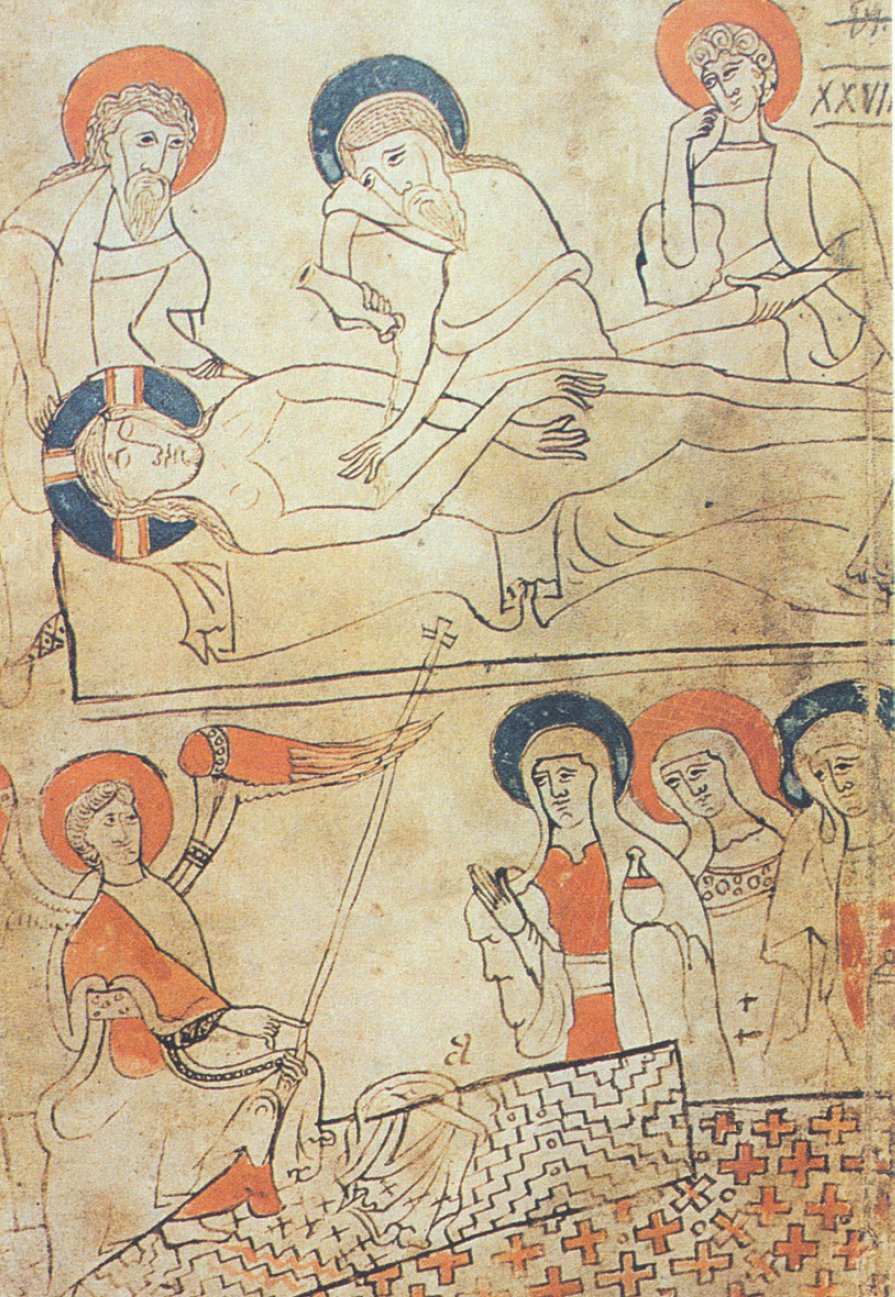
32. Faces, coins, epitaphioi, and the direction of influence
The face on the Shroud is often compared with Byzantine portraits of Christ, including icons and coin types. Broader arguments connect the cloth with images of the dead Christ and later liturgical textiles. These comparisons can reveal shared conventions or possible knowledge of a body-image tradition. Chapter 17 examines facial comparisons more fully; here the issue is what resemblance contributes to provenance.2, 17
A dated icon demonstrates that a visual form existed by the icon’s date. Establishing that the Shroud supplied that form requires a direction of dependence. The opposite direction, dependence on a shared model, and convergence within an artistic convention must also be considered. Dating the comparison object does not automatically date every object that resembles it.
This is particularly important for generic features: a beard, long hair, a central parting, frontal presentation, or crossed hands. More unusual asymmetries may be more informative, but their identification must be reproducible. Image enhancement, scaling, overlays, and selective landmarks can make different faces appear more closely related than an uncontrolled visual impression suggests.
Liturgical textiles depicting the dead Christ introduce another distinction. A cloth bearing a painted or embroidered body can be a representation of the burial rather than a copy of a particular relic. To argue for dependence on Turin, one needs details that are both unusually specific and not already explained by the Passion narrative or an established artistic model.
The strongest contribution of iconography is therefore comparative. It can identify candidate relationships and constrain a proposed history. It is less secure as a substitute for missing transfers, especially when the artwork’s interpretation has already been guided by the identity hypothesis being tested.
33. Wilson and Markwardt: compare each proposed link
Wilson’s model has a clear explanatory attraction: a folded long cloth could account for the public identity of the Edessa image while leaving open its later recognition as a burial shroud. Its main strength is the use of a genuinely documented Edessa-to-Constantinople transfer. Its principal difficulty is identifying the transferred object with a full-body shroud despite the persistent facial tradition and the separate burial-linen entries.2, 17, 20
Markwardt’s Antioch-focused reconstruction draws attention to early Christian networks, other miraculous-image traditions, and alternatives to a direct apostolic Edessa route. His published papers should be read in their own chronological development. It is inaccurate to reduce every version to the same itinerary or to assume that his earlier and later proposals make identical claims. His earliest Antioch paper already challenges the weak historical foundations of the apostolic Abgar route.18, 19
Antioch’s importance makes a transfer possible; it does not supply a receipt for the Shroud. Proposed connections with Peter, displaced Christian communities, or a sacred image require evidence identifying the textile. Likewise, a theory bringing an image into Constantinople earlier than 944 must distinguish that image from the Edessan object that arrived in 944. Otherwise the model resolves one ambiguity by merging another.
The comparative manuscript used for this chapter usefully separates route evidence from object-identifying evidence. That framework should govern the verdict as well as the introduction. Wilson can have the better-attested transfer without having established Turin’s presence in it. Markwardt can expose a weakness in Wilson without establishing an alternative chain. The question is not which story has more episodes, but which individual links withstand examination.2
| Proposal | Explanatory strength | Link still requiring evidence |
|---|---|---|
| Wilson’s Edessa identification | Uses the documented 944 transfer; folding can explain a face-only display | Identity of the image with a full-body cloth; separate relic entries; western bridge |
| Antioch-centered reconstructions | Tests apostolic Edessa assumptions and alternative Christian networks | Specific textile custody and proposed transfers; separation of distinct images |
| Distinct Mandylion and burial cloth | Takes differing functions and inventory entries seriously | Precise identification and later fate of each object |
| Paris continuity for the Mandylion | Tests a recorded western towel or framed-image tradition | Whether general catalogue descriptions identify the Edessan original |
| Medieval origin of the Turin cloth | Fits its clear western emergence and the reported radiocarbon range | Specific production history and a complete account of the object’s properties |
34. Athens, Besançon, Templars, and the missing western bridge
The proposed western bridges after 1204 include Othon de la Roche and Athens, family connections involving the de la Roche and de Vergy names, the Besançon shroud, Templar custody, and other French routes. They are attempts to connect the Byzantine break with the later Charny possession. A careful reconstruction should separate the evidence supporting each proposal from the associations that merely make it imaginable.2, 19, 21
The letter attributed to Theodore Angelos and dated 1205 is frequently used to place a holy burial linen in Athens. Its authenticity, transmission, and interpretation are disputed. Even an accepted reference to a linen in Athens would still need to identify the Turin object and establish its subsequent route. An uncertain document cannot carry a chain more securely than its own textual foundation permits.
Othon’s position in the crusading world is relevant context, not proof that he seized this cloth. A genealogy connecting later families supplies a possible inheritance channel, not an inventory of what traveled through it. Similar names and plausible marriages are particularly vulnerable to retrospective selection unless each relationship and each transfer is independently documented.
The Besançon and Templar proposals present the same methodological problem in different forms. A local shroud tradition need not refer to Turin. Testimony about an image associated with the Templars need not describe a burial textile. A participant’s admission, an interrogation summary, and a later retelling require different treatment, especially in coercive proceedings.
The missing bridge remains missing when these possibilities are assembled without the necessary intermediate records. The theories can guide archival searches. They should not be presented as established travel stages on an otherwise complete itinerary.
35. Lirey: the point at which the cloth becomes recognizable
The middle-fourteenth-century Lirey setting marks a change in the quality of identification. The Charny family, the collegiate church, displays, ecclesiastical disputes, and later possession records concern a cloth that can be followed into the Savoy and Turin history. The sanctuary’s foundation in 1353 should not be confused with an independently dated certificate for the first exhibition. Dates around 1355–1357 depend in part on later testimony and reconstruction.24, 25, 27
Geoffroy de Charny’s reputation, military service, and religious commitments are relevant to his historical setting. They do not establish the circumstances in which he obtained the cloth. A person may sincerely believe a relic genuine without possessing a verifiable account of its first-century origin. Conversely, a missing acquisition record is not proof that its owner commissioned a fraudulent object.
The distinction between the generations also matters. Geoffroy I, Geoffroy II, Jeanne de Vergy, and Marguerite de Charny belong to different stages of the documentary story. Evidence from a later petition may report a prior acquisition; it should not be silently transformed into a contemporaneous bill of sale or a first-person account by Geoffroy I.
Lirey is consequently a baseline rather than a complete solution. It is the place where the investigation has an identifiable western object and a network of records around it. Working backward from that baseline is legitimate. The backward search becomes persuasive when it identifies earlier features uniquely connected to the object, rather than treating the desire for a longer history as evidence that a particular earlier relic was the same cloth.
36. The pilgrim badge and the importance of museum dating
The Lirey pilgrim badge is material evidence associated with the Shroud’s western cult. Its imagery has long been interpreted as a display of the double body image, with heraldic associations linking it to Charny and Vergy. Its object history must be distinguished from the exact date assigned to the earliest Lirey exhibition.19, 24
The official French cultural-heritage record for Cluny inventory CL 4752 dates the badge to the first half of the fifteenth century and specifies before 1453. This catalogue date should be reported alongside the older literature’s association with the first fourteenth-century displays. It is not accurate to label the surviving badge a securely dated souvenir of 1355 without explaining the discrepancy.24
The difference illustrates how a genuine piece of evidence can be made to support a date more precise than its documentation warrants. The badge can strongly attest the Lirey cult and its visual presentation even if it does not independently date the inaugural exhibition. Its significance does not disappear when its chronological claim is narrowed.
Material evidence works best when its own history remains visible: recovery, collection, museum inventory, condition, iconographic interpretation, and proposed dating. The right question is what this surviving badge demonstrates, rather than what date would be most useful for a favored argument. That discipline should apply equally to a medieval badge, a painted miniature, and a modern sample.
37. Pierre d’Arcis: an accusation that must be read as a document
The memorandum associated with Bishop Pierre d’Arcis alleges that the cloth had been presented deceptively, that an earlier investigation exposed its human manufacture, and that an artist acknowledged making it. This is the most consequential medieval accusation in the authenticity debate. It deserves serious attention because it belongs to the period of the identifiable western cloth, not to a distant modern speculation.25, 26
The surviving text is not the artist’s signed confession or a complete transcript of the earlier investigation. It is the bishop’s account of those alleged events, preserved through a document whose drafting, transmission, and date have themselves been debated. No name, workshop, manufacturing instructions, or independently surviving confession should be supplied where the record does not provide them.
Those limits do not make the accusation disappear. An interested or adversarial witness can preserve true information. But a serious use of the memorandum distinguishes what the bishop asserted from what can be checked independently. The same standard applies when defenders suggest financial rivalry, jurisdictional conflict, or misunderstanding: these are historical explanations to test, not automatic grounds for reversing every allegation.25
The chemical question is separate again. If the Turin body image is not explained by an ordinary pigment painting, that result bears on one interpretation of medieval language. It does not prove that no deliberate process could have produced the object. Likewise, a bishop’s use of language translated as painting does not settle the microscopic composition centuries before it was examined.
The memorandum is therefore substantial evidence of a contested medieval cult and an early claim of manufacture. It is neither a complete technical solution nor an irrelevant inconvenience. Its proper place is within the full documentary dossier.
38. Clement VII and the difference between permission and authentication
The Avignon Clement VII’s interventions concern the exhibition dispute within the Western Schism. He should not be confused with the sixteenth-century pope of the same name. The relevant documents include permission, restrictions on presentation, communication with the bishop, and later concessions. Their wording and sequence matter.25
The central restriction associated with January 1390 required the cloth to be presented as a representation rather than the true burial shroud. That is adverse evidence for an unrestricted contemporary ecclesiastical claim of authenticity. It cannot be erased by noting that display was allowed. At the same time, permission to exhibit and efforts to end a jurisdictional conflict should not be converted into a scientific adjudication of the cloth’s manufacture.25, 26
This distinction works in both directions. Indulgences associated with visiting a church do not certify the physical origin of every object displayed there. A command to an opposing bishop to stop obstructing an exhibition does not establish that his factual allegations were investigated and disproved. A restriction on the claim made to pilgrims does not reveal a workshop process.
The documents must be compared in their manuscript and registered forms, with alterations and differences reported rather than smoothed into a single convenient verdict. The resulting picture is of a church administration managing a contested devotion. It does not justify the slogans that the medieval papacy either conclusively authenticated the Shroud or experimentally exposed its production.
39. Savoy, Chambéry, and Turin: a stronger custody history
After the Lirey period, the record becomes more continuous. The transfer from Marguerite de Charny into Savoy possession in 1453 provides a major legal and dynastic landmark. The cloth’s later place at Chambéry and its arrival in Turin in 1578 belong to a history supported by substantially more specific institutional records than the proposed apostolic and early Byzantine route.27
The fire of December 1532 and the repairs undertaken by the Poor Clares in 1534 connect documentary events with conspicuous physical changes. Folded storage helps explain repeated areas of damage. The image, earlier holes, major burns, repair patches, and water boundaries should nevertheless be studied as different features; a single disaster need not explain every mark now present.28, 29
The move to Turin was associated with the Savoy political setting and the pilgrimage of Charles Borromeo. Subsequent exhibitions, custody, photography, sampling, and conservation created an expanding record of an identifiable object. That record allows much more exact comparison between reports and material evidence than is possible for an ambiguous early notice.
Modern conservation is part of the biography, not an interruption of it. The 2002 work changed the supporting textile and removed the older patches and material at damaged areas. Removed components were retained and documented by the custodians. A modern photograph therefore should not be compared with an older copy as though the cloth’s mounting and repairs had never changed.35
These later events establish continuity for the western object and help interpret its present condition. They do not retrospectively authenticate a first-century origin. A securely documented five-century journey can be real even when the proposed earlier thirteen centuries remain disputed.
40. Photography, laboratory science, and historical identity
Secondo Pia’s photographs, the later photographic record, and the 1978 STURP examination transformed access to the cloth. Researchers could investigate features that earlier devotional observers had not described in equivalent detail. STURP’s published synthesis distinguished the body image from an ordinary pigment-and-binder painting and did not identify a complete image-formation mechanism. Those findings concern the material object, rather than a documented itinerary through Edessa.33
This separation is essential because an unusual object invites unusual historical expectations. If a mechanism remains unresolved, researchers may reasonably search earlier image traditions for evidence of the same phenomenon. But the inability to explain an image is not a calendar date. The historical identification still requires descriptions or connections capable of distinguishing the Turin textile from other objects.
The opposite inference also fails. If a disputed ancient identification is weakened, the cloth’s remaining optical and chemical questions do not cease to exist. A failed Edessa link would remove one proposed biography, not automatically supply a medieval production method. An accurate account should allow results in different fields to remain different until there is evidence connecting them.
This is why the history of investigation belongs within the cloth’s biography. Photography changed what observers could see. Sampling changed what laboratories could test. Digitization changed which manuscripts and images could be compared. Each development can improve the inquiry, while also creating opportunities to read newly noticed features backward into texts that never explicitly described them.
41. Radiocarbon dating and the medieval documentary horizon
The 1988 radiocarbon measurements, reported in 1989, gave the sampled material a calibrated range of 1260–1390 CE at at least 95 percent confidence. That result lies close to the cloth’s identifiable emergence in the western historical record. The correspondence is significant and must be addressed by any first-century identification.30
It should not be overstated. First surviving documentation is not a direct measurement of manufacture. An object can be older than its first clear record. Nor were the laboratories investigating an object whose medieval documentary history was unknown to the world. The analytical procedure and archival reasoning are different evidentiary methods; calling them different does not require the inaccurate claim that the analysts knew nothing about the historical controversy.
Rogers’s 2005 paper argued that material from the sampling region differed chemically from other cloth material and challenged its representativeness. This is a substantive published sampling argument, not an independent measurement establishing a first-century date for the entire textile.31
The 2026 examination by Freer-Waters and Jull of two retained fragments reported features consistent with the main cloth and no evidence of contamination in those examined fragments. That result bears on claims that the retained material is obviously anomalous. Its scope is still the fragments studied; it is not a new geographically distributed radiocarbon dating program.32
Chapter 19 treats the technical dispute in depth. For this historical chapter, the conclusion is sufficient: the medieval dating result remains substantial contrary evidence for an ancient identity, while sampling and interpretation need to be assessed in their proper scientific detail. A textual hypothesis cannot annul a laboratory result by narrative force, and a laboratory date does not explain every earlier relic reference.
42. How to weigh silence and convergence without counting twice
An argument from silence is strongest when a source had reason and opportunity to mention the thing in question. Egeria’s Edessan visit, an inventory naming several comparable relics, and a theological controversy involving images each create different expectations. The absence of an entry in a lost local archive is different from the absence of any mention across a widely transmitted literature. Those differences should be investigated rather than reduced to the maxim that silence proves nothing.
The inverse maxim is equally unsafe. An object’s absence from surviving records does not prove that it never existed. Historical survival is uneven. Secrecy, destruction, restricted access, and ordinary neglect can all remove traces. They become explanatory hypotheses when applied to a particular gap; they become persuasive when additional evidence favors them over alternatives.
Convergence also requires independence. Five modern books quoting one medieval passage are not five medieval witnesses. Several Greek versions descending from a shared text are not automatically independent observations. Several facial overlays based on the same photograph are transformations of one visual dataset. A catalogue’s length can show the breadth of a tradition while overstating the number of independent identifications.2
The strongest cumulative argument therefore maps dependencies. Which observations come from the cloth itself? Which from separate documents? Which from inherited stories? Which were selected because they fit the reconstruction? A conclusion gains weight when independent evidence constrains the same object in different ways. It gains less when one initial identification is repeatedly restated as though it had been independently rediscovered.
| Claim | Evidentiary status |
|---|---|
| The Gospels name burial linens | Explicit textual evidence; no onward inventory |
| Eusebius reports a cloth portrait | Absent from his Abgar account |
| Edessa had a developed image cult | Historically well attested by the Byzantine period |
| The Edessan image reached Constantinople in 944 | Strongly documented transfer |
| Gregory explicitly saw a side wound on the image | Not supported by Guscin’s corrected reading |
| A folded full-body cloth could appear face-only | Geometric possibility, with identity and date unresolved |
| Robert reports an image-bearing burial shroud | Significant testimony; identification with Turin remains additional |
| The Pray miniature independently dates the Shroud | Only if dependence on the Turin cloth is first established |
| CL 4752 is securely dated to a 1355 exhibition | Official catalogue instead dates it to early fifteenth century, before 1453 |
| A continuous first-century-to-Turin provenance is established | Not demonstrated |
| Later western custody is substantially stronger | Supported by converging institutional and material records |
43. Research that could change the historical assessment
The most productive historical work would publish a critical dossier rather than another seamless itinerary. For each candidate passage, the dossier should provide the manuscript identifier, the relevant page or folio, the original wording, textual variants, a translation, the dates of composition and copying, and a clear statement of what object features are explicit. Readers should be able to inspect the steps between text and conclusion.
The same discipline should govern material comparison. A study of the Pray miniature should prespecify the proposed features and compare a substantial corpus of burial scenes, including examples that do not resemble Turin. A folding study should test alternative geometries against measured creases and damage. A genealogical hypothesis should identify the documents establishing each relationship and each alleged property transfer. A name repeated across a family tree is not yet a chain of possession.
New archival discoveries would be particularly important if they described distinctive front-and-back images, unusual dimensions, a recognizable constellation of damage, or a transfer between named custodians. Another generic reference to Christ’s burial cloth would enrich the history of relic devotion but might not narrow the Turin identification. The research question should specify which kind of discovery would discriminate between competing histories.
Scientific work can contribute independently. Better material dating, geographically distributed characterization, and careful documentation of repairs could strengthen or weaken assumptions on which historical models depend. Such work needs conservation approval and a sampling design that answers a defined question. Repeating an old measurement without addressing its disputed representativeness would not necessarily resolve the debate.
Finally, the competing reconstructions should be allowed to fail at particular links. An argument that explains every contrary result as concealment or confusion becomes difficult to test. A stronger proposal states what finding would require revision. That openness is a practical research standard, not a concession that the subject is unworthy of serious inquiry.
Conclusion: a real history and a conditional identification
The Shroud’s historical problem is not a choice between an uninterrupted apostolic biography and an object without a past. The western cloth has a real and substantial history. Edessa’s image had a real cult and a documented transfer. Constantinople had a differentiated collection of Passion relics and a remarkable report of an image-bearing burial cloth. The unresolved issue is the identity connecting these histories.
Wilson’s folded-cloth model makes that connection intelligible, but does not establish every link. Markwardt’s alternatives expose questions a single route can overlook, while carrying evidentiary burdens of their own. Gregory’s homily remains valuable after its side-wound reading is corrected. The Pray Codex remains worth comparing after its interpretation is separated from its date. The Lirey documents remain consequential when their allegations, permissions, and restrictions are read together.
Christian faith need not depend on forcing those sources into certainty. John Paul II’s 1998 address explicitly distinguished the historical and scientific questions from a matter of faith and encouraged investigation without predetermined results. That position allows the object to retain its religious significance while its material and documentary claims are examined openly.34
The defensible conclusion is therefore precise. A continuous first-century-to-Turin provenance has not been demonstrated. Several earlier traditions provide serious candidates for investigation, with different degrees of relevance and specificity. The later medieval and modern chain is much stronger. The hidden thread may preserve elements of a longer biography, but the task of history is to identify where the thread is actually visible and where a proposed connection still has to be made.
References and descriptive source notes
- Biblical burial and empty-tomb accounts. Matthew 27:57-61; Mark 15:42-47; Luke 23:50-56; John 19:38-42 and 20:1-10. Source link ↗Primary literary witnesses to burial linens; none provides a subsequent chain of custody to Turin.
- Grasso, Otangelo. Pre-1350 Shroud Trajectories: Wilson vs. Markwardt - A Comparative Historical Analysis. Author-supplied comparative manuscript, 29 pages; read alongside the existing Chapter 16 and the author's historical discussion. Source link ↗Working synthesis used to identify claims for checking. Its supplied date, manuscript identifiers, lexical arguments, and proposed custody links are not treated as independently established facts. The link is the author's related public discussion, rather than the supplied PDF.
- Jerome. On Illustrious Men, chapter 2. Late-fourth-century work; English translation in Nicene and Post-Nicene Fathers, reproduced by New Advent. Source link ↗Preserves the Gospel according to the Hebrews fragment about a linen cloth and a priest's servant. The surviving quotation is in Jerome and does not identify an image-bearing Turin cloth.
- Eusebius. Ecclesiastical History, I.13. Early-fourth-century account of Abgar, the correspondence, and Thaddaeus; English translation reproduced by New Advent. Source link ↗Primary witness to the Abgar tradition. This version contains no portrait carried on a cloth.
- Egeria. The Pilgrimage of Etheria, the Edessa visit. Late-fourth-century pilgrimage narrative; McClure and Feltoe translation, Christian Classics Ethereal Library. Source link ↗Describes Abgar-related sites and the protective letter. The absence of an image in the surviving account is a contextual silence, not proof that no image existed.
- The Doctrine of Addai. Syriac Abgar narrative; George Phillips's 1876 English translation, reproduced by CCEL. Source link ↗Explicitly describes Hannan making a portrait with paints. Its portrait episode must be distinguished from later miraculous-imprint narratives.
- Procopius. History of the Wars, Persian Wars II.12 and II.26-27. Sixth-century work; H. B. Dewing translation, LacusCurtius, University of Chicago. Source link ↗Primary account of the Edessan siege and military operations. The earlier Abgar discussion is in II.12, linked within the edition.
- Evagrius Scholasticus. Ecclesiastical History, IV.27. Late-sixth-century work; E. Walford's 1846 translation. Source link ↗Primary witness to an Edessan image credited with divine manufacture and protection during the 544 siege. It is a later report of that event, not a description identifying Turin's double image.
- Acts of Thaddaeus. Greek apocryphal narrative; English translation in Ante-Nicene Fathers, volume 8, reproduced by New Advent. Source link ↗Primary facial-imprint narrative associated with the tetradiplon debate. Composition, surviving copies, and the apostolic setting are different chronological questions.
- Fulbright, Diana. A Clean Cloth: What Greek Word Usage Tells Us about the Burial Wrappings of Jesus. 2005 conference paper, reprinted in BSTS Newsletter 62. Source link ↗Original lexical discussion of sindon and related textile terms, including tetradiplon. Proposed word meanings do not independently establish an object's dimensions or provenance.
- John of Damascus. On Holy Images / Exposition of the Orthodox Faith. Eighth-century theological text; S. D. F. Salmond translation excerpt hosted by McGill University. Source link ↗Primary use of the Abgar image tradition in image theology; qualifies claims that the tradition was wholly absent from icon-related debate.
- Guscin, Mark. The Tradition of the Image of Edessa. Doctoral thesis, Royal Holloway, University of London; submitted 2014, repository version 2015. Relevant passages and documentary discussions consulted. Source link ↗Original textual research, including a critical edition and translation of the Narratio. The chapter uses selected relevant sections, rather than claiming a complete new collation of every manuscript.
- Dubarle, Andre-Marie. L'homelie de Gregoire le Referendaire pour la reception de l'image d'Edesse. Revue des etudes byzantines 55 (1997), 5-51. DOI: 10.3406/rebyz.1997.1935. Source link ↗Critical edition, translation, and study of the reception homily. Read with Guscin's subsequent correction of the side-wound interpretation.
- Guscin, Mark. The Sermon of Gregory Referendarius. English translation and introduction, 2004. Source link ↗Original translation publication. Its strong introductory claim about a side wound was subsequently revised and must not be repeated without the addendum.
- Guscin, Mark. Addendum to Translation of Sermon by Gregory Referendarius. Dated December 2007; posted January 2008. Source link ↗Explicitly withdraws the interpretation that the image was embellished by blood from Christ's side, distinguishing the bodily events instead. It does not retract every other proposed Edessa-Turin connection.
- Flusin, Bernard. Didascalie de Constantin Stilbes sur le mandylion et la sainte tuile (BHG 796m). Revue des etudes byzantines 55 (1997), 53-79. DOI: 10.3406/rebyz.1997.1936. Source link ↗Edition and study of a pre-Fourth-Crusade Byzantine text concerning the Mandylion and tile; supports the differentiated relic context.
- Scavone, Daniel. A Review of Recent Scholarly Literature on the Historical Documents Pertaining to the Turin Shroud and the Edessa Icon. Orvieto conference paper, 2000. Source link ↗Original historical argument for investigating the connection, including textual and iconographic comparisons. Its hypotheses and stronger scientific assumptions are distinguished from independently established facts.
- Markwardt, Jack. Antioch and the Shroud. 1998; revised 1999. Source link ↗Original presentation of an Antioch-centered alternative. Its proposed custodians and transfers are assessed as reconstructions.
- Markwardt, Jack. Modern Scholarship and the History of the Turin Shroud. 2014 conference paper. Source link ↗Later development of Markwardt's historical case and criticism of competing reconstructions. Earlier and later versions of his route are not assumed identical.
- Nicolotti, Andrea. From the Mandylion of Edessa to the Shroud of Turin: The Metamorphosis and Manipulation of a Legend. Brill, 2014. DOI: 10.1163/9789004278523. Institutional record and stated argument checked. Source link ↗Specialist challenge to the identity claim. The publication year is 2014, rather than the incorrect 2020 attribution in the previous essay. The complete monograph was not available for a fresh full reading.
- Nicolotti, Andrea. The Shroud of Turin: The History and Legends of the World's Most Famous Relic. Baylor University Press, English edition; publisher's record and contents consulted. Source link ↗Broader historical countercase and further reading. Detailed archival claims are checked against the accessible documents and editions rather than attributed to an unread full volume.
- Robert de Clari. The Conquest of Constantinople, chapter 92. Early-thirteenth-century participant's chronicle; translation hosted by the Society for Medieval Military History, De Re Militari. Source link ↗Primary report of a burial shroud at Blachernae, a Friday elevation, a visible form, and an unknown fate after the conquest. It does not specify Turin's dimensions or double image.
- National Szechenyi Library. Pray-kodex - Halotti beszed es konyorges. Official manuscript description, Budapest; shelfmark MNy 1. Source link ↗Institutional dating of the main copying phase to 1192-1195. That date belongs to the manuscript, not automatically to the Turin cloth.
- French Ministry of Culture / Musee de Cluny. Enseigne de pelerinage: Saint Suaire, CL 4752. Joconde / POP record 50030001918. Source link ↗Official catalogue dates the badge to the first half of the fifteenth century, before 1453. This differs from older arguments assigning it directly to the earliest fourteenth-century exhibitions.
- Fossati, Luigi. A Critical Study of the Lirey Documents. Shroud Spectrum International 41, translated study, pp. 2-11. Source link ↗Document-by-document discussion of the memorandum, papal interventions, and manuscript variants. Its authenticist interpretation is reported as an interpretation.
- Pierre d'Arcis. Memorandum concerning the Lirey cloth. Traditionally dated c. 1389; Herbert Thurston's English translation reproduced online. Source link ↗Accessible primary-text translation of the accusations, including the alleged earlier inquiry and artist's admission. It is not the artist's own confession; drafting and transmission remain part of the assessment.
- Official Shroud custodial website. Historical Outline. Santa Sindone, Turin. Source link ↗Custodial account of the identifiable western history, including Lirey, the 1453 Savoy transfer, Chambéry, and the 1578 move to Turin.
- Official Shroud custodial website. The Fire. Santa Sindone, Turin. Source link ↗Custodial description of the 1532 fire and the 1534 repairs. Those events must be distinguished from other damage on the cloth.
- Official Shroud custodial website. The Cloth - earlier descriptive record. Archived descriptive page on the material features of the Shroud. Source link ↗Notes earlier holes and the dated 1516 Lier copy. A pre-1532 damage limit is different from an independently established twelfth-century limit.
- Damon, P. E., et al. Radiocarbon dating of the Shroud of Turin. Nature 337 (1989), 611-615. DOI: 10.1038/337611a0. Source link ↗Primary three-laboratory dating report: calibrated 1260-1390 CE at at least 95 percent confidence for the sampled material.
- Rogers, Raymond N. Studies on the radiocarbon sample from the Shroud of Turin. Thermochimica Acta 425 (2005), 189-194. DOI: 10.1016/j.tca.2004.09.029. Source link ↗Primary chemical challenge to sample representativeness; it is not a new direct first-century radiocarbon date for the main cloth.
- Freer-Waters, R., and Jull, A. J. T. Analysis of textile fragments from the 1988 radiocarbon samples of the Turin Shroud. npj Heritage Science 14 (2026), article 263. DOI: 10.1038/s40494-026-02530-7. Source link ↗Primary examination of two retained fragments. Its reported consistency and lack of observed contamination are limited to the material examined.
- Shroud of Turin Research Project. A Summary of STURP's Conclusions. Official 1981 summary, reproduced by the Shroud of Turin Education and Research Association. Source link ↗Primary team synthesis on the image and material observations. It does not establish a documented route through Edessa.
- John Paul II. Address at the Cathedral of Turin before the Shroud. 24 May 1998, Vatican text. Source link ↗Primary statement distinguishing the historical and scientific questions from a matter of faith and encouraging research without predetermined conclusions.
- Official Shroud custodial website. The Restoration. Santa Sindone, account of the 2002 conservation work. Source link ↗Custodial record of the removal of older patches and backing, documentation, and retention of removed components.
- Wilson, Ian. The Shroud: Fresh Light on the 2000 Year Old Mystery. Bantam / Transworld, 2010; earlier foundational formulation in The Shroud of Turin: The Burial Cloth of Jesus Christ? (Doubleday, 1978). Source link ↗Foundational modern identification hypothesis and further reading. Publisher metadata checked; the reconstruction is assessed through the cited texts and competing historical studies, not presented as settled provenance.
- Klein, Holger A. Sacred Relics and Imperial Ceremonies at the Great Palace of Constantinople. In F. A. Bauer, ed., Visualisierungen von Herrschaft, BYZAS 5 (2006), pp. 79-99. Source link ↗Original historical study of palace relics and ceremonies, especially the Pharos setting, rebuilding, acquisitions, and the differentiated late-twelfth-century collection. Its critical treatment of the purported Alexios letter is retained.
- Gods' Collections. The Church of the Virgin of the Pharos in Constantinople. Research case study with translated extracts from Mesarites and references to Mango, Heisenberg, and the surviving reliquary evidence. Source link ↗Accessible contextual discussion and primary-text extracts. The source distinguishes sacred geography, relic contemplation, and the difficulty of reconstructing the church's display.
- Scavone, Daniel C. Acheiropoietos Jesus Images in Constantinople: The Documentary Evidence. Author's documentary study, revised through 7 October 2006, 29 pages; especially Documents IV-XVI and the notes. Source link ↗Selected translated documentary excerpts and original arguments about the 958 address, pilgrims, Mesarites, Clari, post-conquest testimony, and the 1247 transfer record were examined. Its proposed object identifications and transfer scenarios remain arguments. Its older side-wound reading is superseded here by Guscin's addendum, reference 15.
- Nicolotti, Andrea. Una reliquia costantinopolitana dei panni sepolcrali di Gesu secondo la Cronaca del crociato Robert de Clari. Medioevo Greco 11 (2011), pp. 151-196. Institutional full-text copy, University of Tubingen; publication record at the University of Turin. Source link ↗Relevant passages and documentary quotations examined for Blachernae, the Old French notice, the distinction from the southern palace, and the proposed confusion with the Marian Friday miracle. The interpretation is assessed as a competing explanation, not assumed as a settled verdict.
- Mesarites, Nicholas. Relics of the Passion in the Church of the Pharos in the Account of the Usurpation of John Komnenos the Fat. In Foteini Spingou, ed., Sources for Byzantine Art History, Cambridge University Press (2022), I.6.6, pp. 716-724. DOI: 10.1017/9781108672450.066. Source link ↗Modern primary-text edition/translation reference. Publisher metadata and preview were checked; the complete chapter was not accessible. The wording discussed in this essay was compared through the accessible translated extracts in references 38 and 39.
- Psellos, Michael. Discourse on the Miracle That Occurred in the Blachernae Church, translated by Elizabeth A. Fisher. In Michael Psellos: On Symeon the Metaphrast and On the Miracle at Blachernae, Center for Hellenic Studies (2014), chapter 5, especially sections 5.1, 5.4 and 5.14. Source link ↗Relevant translated sections read in a credited republication linking the original Harvard edition. Describes the Marian icon and its lifting drapery. The Harvard publication record was separately checked; this is independent primary testimony to the earlier ceremony, not a Shroud inspection.
- Mesarites, Nicholas. His Life and Works, translated with notes and commentary by Michael Angold. Liverpool University Press (2017), Translated Texts for Byzantinists 4; especially Narrative of the Coup of John the Fat and Epitaphios for His Brother John, pp. 31-74 and 134-192. DOI: 10.2307/jj.38238883. Source link ↗Publisher information, contents, and chapter previews checked, including the 1200/1201 dating problem and the funeral oration delivered on 16 March 1207. The entire translated volume was not available for a fresh reading; detailed relic comparisons use the accessible excerpts in reference 39.
- Mesarites, Nicholas. Account of the Capture of Constantinople. English translated extract reproduced by Myriobiblos in its collection on the capture of 1204. Source link ↗Primary witness to violence and the violation of sacred places. Used for the circumstances of disruption; it is not an inventory establishing the destination of a named shroud.
AI assistance was used in research organization, drafting, editing, and document preparation. Historical illustrations and explanatory schematics are identified in their captions. Interpretive identifications are distinguished from documented transfers and material observations.