IN-DEPTH READING
The evidence in context
This chapter presents historical, scientific and medical interpretations of the Shroud. Some conclusions remain debated. A source note identifies the related work1.
I. The Darkroom
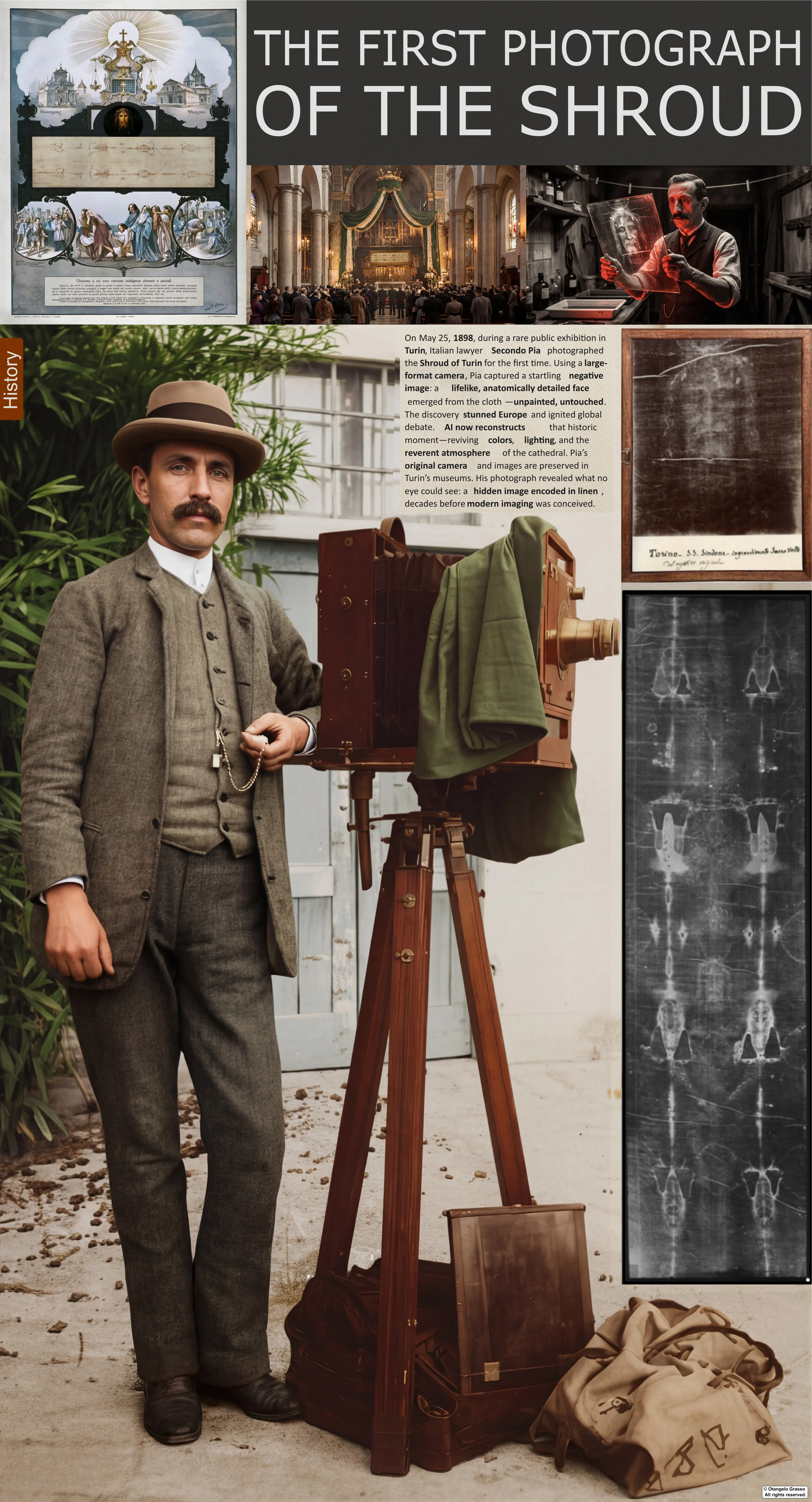
Turin, May 28, 1898. Late in the evening, in a darkroom on the Via Berthollet, a 42 -year-old lawyer stood in the amber glow of a safelight, watching something emerge from a tray of chemicals.1
Secondo Pia had photographed many things in his career — monuments, landscapes, the architectural treasures of Piedmont. Over 13,000 photographs, accumulated across a lifetime of patient documentation.2 He was careful, methodical, precise. He was not a man given to strong emotion in the darkroom.
Image 5.1 The two portraits bridge more than a century of photographic history. On the right, the original late -19th-century studio photograph presents Secondo Pia as the world first knew him - rendered in soft sepia tones, formal, restrained, unmistakably of the fin-de-siècle era in which he photographed the Shroud of Turin. On the left, a modern restoration and colorization reintroduces texture, depth, and lifelike presence, transforming a historical record into something that feels immediate and human. Together, the images contrast not only past and present, but the evolving power of photography itself: from documentation to revitalization.
Hours earlier, he had stood on an approximately 3.35 -meter platform in Turin Cathedral, his massive plate camera aimed at the Shroud of Turin suspended behind glass above the altar. 1 Electric arc lamps — still a novelty in 1898 — had bathed the ancient linen in harsh artificial light for long exposures while he held the shutter open, willing the temperamental
equipment not to fail as it had three days before. Four exposures. Four giant 50×60 centimeter glass plates.1 The weight of those minutes pressed into every one.
Now, in the chemical bath, the best of those plates was beginning to speak.
He had expected to see the familiar inversion of a photographic negative — light where there was dark, dark where there was light. He had expected the shadowy, confusing smudges that everyone saw when they looked at the Shroud with their naked eyes, only reversed. He had expected, in short, to make things worse. A negative of an already-hard-to-read image would be doubly illegible, a technical exercise for the archives. He leaned closer to the tray. Then he went still.
What he got instead was a face. Not a painting. Not a drawing. Not a death mask or a Byzantine icon or a medieval artist's imagination. A face so anatomically precise, so dimensional, so hauntingly alive in its death that Secondo Pia felt the air leave the room. The thought arrived whole and without warning: this image was never meant to be seen this way — and yet here it is, waiting. He stood without moving for a long moment, his hands above the tray, not quite believing what his eyes were recording. According to later accounts, Pia, astonished, called out to his brother Carlino with words to the effect of, "Look, if this isn't a miracle."3
What Pia had discovered — though he lacked the vocabulary to name it precisely — was that the image on the Shroud behaves as a photographic negative. Not a positive image that photography had reversed, but an image that photography revealed with uncanny cl arity, showing what no human eye had ever been able to properly see.4
The argument is sometimes made that for this to be a forgery, the forger would have needed to grasp a visual concept for which there was no formal framework before the development of photography in the 1820s and 1830s. While the formal science of photograp hy was centuries away, the claim that a medieval forger could not conceive of a negative image is overstated. Artistic techniques like relief printing and metalwork involved a similar logic of tonal inversion. However, creating an image as detailed and anatomically precise as the Shroud's negative, with no obvious artistic medium, would have been a monumental and wholly unprecedented technical feat for any pre-modern artist.4
II. The Setup — How the Most Important Photograph in History Almost Didn't Happen
The Political Gamble
By 1898, the Shroud had become what you might call a recluse relic. The House of Savoy, which owned it, had publicly displayed it only a handful of times in the entire nineteenth century. Each exhibition was brief, each
rationale political — a royal wedding, a diplomatic visit, a celebration of dynastic power. The Shroud wasn't for the masses. It was a tool of statecraft, a symbol of divine right wrapped in yellowed linen and locked in a silver casket behind iron grilles in the Chapel of the Holy Shroud.
Image 5.2: Photo of the square of the Cathedral during the 1898 exhibition. Source Link
Then came Italy's jubilee year. The nation was celebrating the fiftieth anniversary of the Albertine Statute, the constitutional charter of the Kingdom of Sardinia-Piedmont that became the foundational document of unified Italy.4 Turin would host the festivities. Catholics in the city saw their chance: a Sacred Art Exhibition alongside the General Italian Exhibition — and yes, a public display of the Shroud.4
The idea was not universally popular. King Umberto I had inherited a complicated relationship with the Church. Displaying the Shroud prominently might seem like pandering to clerical interests at a moment when the monarchy needed to project secular strength. But Baron Antonio Manno — lawyer, historian, patron of the arts — was persuasive. The Shroud was a cultural treasure, a draw for the hundreds of thousands of visitors who would descend on Turin. And perhaps it was time to let someone photograph it. Not for publication. Not for mass reproduction. Just for the archives.
The idea had precedent. Fifty-six years earlier, during the 1842 exhibition, accounts mention an attempted daguerreotype photograph of the Shroud by a local craftsman named Enrico Jest, but the proposal was reportedly rejected, and the attempt was never carried out..5
The Accidental Choice
Secondo Pia was not the obvious choice. He was not even, technically, a professional photographer. By trade he was a lawyer from Asti, a city councilor with a respectable practice. Photography was his passion, not his profession. But he was serious: over 13,000 photographs across a lifetime,
documenting the architectural and cultural heritage of Piedmont. 2 He knew his way around chemicals and optics. And crucially, he had something else: disinterest. He was not in it for glory or money. He was a patriot, a servant of culture.
Image 5.3: How the Cathedral looked during the 1898 Exhibition. Source Link When Baron Manno recommended him, the choice made a certain aristocratic sense. Pia embodied the amateur ideal — competence without commerce, expertise without ego. He would not try to sell the photographs to newspapers. He would not grandstand. He would do the job, deliver the plates, and return to his legal practice and his wanderings through Piedmont with his camera.
Except that no one — not Baron Manno, not King Umberto, not Secondo Pia himself — had any idea what they were about to unleash.
The Technical Nightmare
Photographing the Shroud in 1898 was not like photographing a building or a landscape. The cloth measured 4.37 meters long and 1.10 meters wide — approximately fourteen feet four inches by three feet seven inches. 6 It could not be taken down from its display frame. It could not be brought outside. It had to be shot exactly where it hung: suspended above the main altar of Turin Cathedral, behind a sheet of protective glass, in lighting conditions that would make any photographer wince.
The glass meant reflections — glare, distortion, hot spots bouncing off artificial light at every angle. The height required a custom platform just to position the camera correctly. The platform had to be stable enough to hold a 50×60 centimeter plate camera — any vibration during the exposure would blur the image beyond recovery. And the exposure time: photographic plates in 1898 were not sensitive enough for quick work, especially in dim interiors. Pia would need to hold the shutter open for minutes. Eight minutes. Twelve minutes. Fourteen minutes. Long enough
for the arc lamps to overheat. Long enough for a footstep, a breath, a door closing somewhere in the vast cathedral to turn the image into a smeared ghost.1
It was, in short, a logistical and technical nightmare. Which is why the first attempt, on May 25, 1898, failed.
III. Trial and Error — The First Glimpse
On the evening of May 25, Pia set up his equipment with meticulous care. He was assisted by Don Nogier de Malijai, Don Solano, and Lieutenant Felice Fino, the head of cathedral security.1 The platform, the camera, the electric lamps, the cables snaking across the cathedral floor. Everything had been tested and rechecked. The Shroud hung before him like a pale banner, its faint markings barely visible to the naked eye even with the artificial lights blazing.
Then the lamps failed. Not dramatically — no sparks, no smoke — just the quiet betrayal of unreliable technology stuttering and going dark at the worst possible moment. Pia managed two exposures before the equipment gave up entirely. They were flawed: move ment blur, uneven lighting, technical imperfections.1
But when he developed them later that night, something caught his eye. A strange effect. In the negatives — where light and dark should be reversed, where the faint smudges on the Shroud should have become even more confusing — there was instead an unexpec ted clarity. A suggestion of dimension. The hint of a face.
He did not tell anyone. Not yet. The exposures were flawed; the evidence inconclusive. What if it was an artifact of the glass, a trick of the lighting, an optical illusion born of poor technique? He needed to try again. He needed to be certain.
IV. The Revelation — What Secondo Pia Saw
Three days later, on the night of May 28, Pia returned to Turin Cathedral. This time he was not alone. Don Nogier de Malijai was there. So was Lieutenant Felice Fino, head of cathedral security and a photography enthusiast. They would take their own unoffi cial exposures, insurance against accusations of trickery.1
At 9:30 PM, the arc lamps hummed to life and held steady. 7 Test exposures first. Then the moment of commitment. Pia loaded his best Voigtländer lens — precision German optics — and prepared the official plates. He used a straw-yellow filter to enhance tonal contrast, a standard technique. He calculated the exposu res with mathematical precision: the plates were exposed for 8, 10, 12, and 14 minutes.1 The cathedral fell silent except for the electric hum and the ticking of his pocket watch. Fourteen
minutes is an eternity when you are standing on a platform holding your breath, willing the world to stay still.
When the final exposure was complete, Pia closed the shutter, removed the plates, and hurried to his darkroom. He would develop them immediately, that very night.
As the first faint traces of the image began to appear in the chemical bath, he leaned closer. The usual inversion was there — the black burn marks from the 1532 fire had turned white; the white repair patches from 1534 had turned black. The negative was d oing what negatives do. But the figure on the cloth — the mysterious, faint double image of a man that had baffled artists and theologians for centuries — was not inverting. It was resolving. Clarifying. Becoming more real. Where the naked eye saw shadowy, hard-to-interpret smudges, the negative revealed natural shading, three -dimensional relief, anatomical precision. Where artists' copies had always turned the Shroud face into a grotesque mask, the photographic negative showed a dignified human countenance , eyes closed, features at rest.3
Image 5.4: Bathed in the crimson glow of the darkroom, the moment feels suspended between science and astonishment. Secondo Pia grips the fragile glass plate, his expression caught in that rare instant when expectation collapses into revelation. On the translucent surface, a face— solemn, human, unexpectedly alive—emerges from what should have been a mere inversion. The red light, the chemicals, the silence of the room: all become witnesses to a discovery that blurs the boundary between technical procedure and profound wonder.
What Secondo Pia realized in that moment was something that would shake the foundations of Shroud studies for the next century and beyond: the image on the cloth behaves as a photographic negative — created somehow, by some unknown process, centuries befor e the invention of photography.
The face that emerged had dimension — not the flat, stylized features of Byzantine icons or medieval paintings, but the subtle modeling of real human anatomy. The nose had a bridge and a tip. The cheekbones cast shadows. The closed eyelids had depth. The b eard was not a decorative flourish but actual facial hair, with texture and direction. The bloodstains behaved differently from the body image: on the Shroud they appeared dark red to brown; in the negative they turned white. Blood and body image were sepa rate layers of evidence, whatever had created them operating by different mechanisms. The wounds were rendered with forensic precision: puncture marks in the wrists not the palms, a wound in the side, scourge marks across the torso, lesions around the scal p consistent with a thorned cap rather than the crown of Western artistic tradition.4
Secondo Pia stood at the threshold of his darkroom, the large plate still dripping with fixative, and called softly to Carlino waiting outside. The young man came in and saw the look on Pia's face — wonder threaded through with something close to shock. Th ey looked at the plate together without speaking. Then Pia said it again, almost to himself: "Look, Carlino, if this is not a miracle."
V. Scandal and Skepticism — The World Reacts
The News Leaks
King Umberto I and his advisors were unprepared for what Pia had found. The plan had been simple: take some archival photographs, store them in the royal collections, move on. Instead, they now possessed what appeared to be scientific evidence of something inexplicable. The political implications were immediate and vast. They agreed to keep it quiet until they could consider the ramifications.
But secrets of this magnitude do not stay secret. Within days, the news leaked. On June 1, 1898, L'Italia Reale Corriere Nazionale ran the first report.4 Soon after, one of the unofficial photographs — taken by Don Nogier or Felice Fino during the session — found its way into print. The revelation spread through European newspapers and journals with the velocity of a scandal.4 Early Press Reports on Secondo Pia's 1898 Shroud Photograph
Image 5.5: Early press coverage of Secondo Pia's discovery, spanning Paris, Florence, Berlin, Genoa, and Rome. Even secular papers described the revelation in language infused with awe.
The year 1898 marked a turning point in the modern history of the Shroud of Turin. What is striking is not only the rapidity of the coverage — spanning Paris, Florence, Berlin, Genoa, and Rome — but the tone: even secular papers described the discovery in language infused with wonder.
Two of the earliest and best -documented notices survive: one from Paris (L. Courrier de la Presse , carried into Berlin), and one from Florence (L'Unità Cattolica ). Together they reflect the international impact of a moment that would permanently alter the dialogue between science, faith, and the Shroud.
1. German Notice Source: L. Courrier de la Presse, Paris. Archival stamp: Berlin, June 1, 1898. Addressed: Norddeutsche Allgemeine Zeitung (Berlin).
"The 'Director of Monuments' in the holy city announced on May 25 that the Holy Shroud, preserved in Turin, would be publicly displayed during the present religious celebrations. On this occasion, the lawyer Mr. Secondo Pia, who has the honor of serving as photographer to the King and as a member of the city council of Turin, was granted permission to photograph the Holy Shroud. To his astonishment, he witnessed the appearance of an image of the Holy Body, with all the details which
science has confirmed, details which until then could not be perceived on the relic. This image shows a human face, which, in all its anatomical details and with the agreement of all experts, presents a striking veracity. The news of this has spread like an electric shock and everywhere aroused the greatest excitement."
2. Italian Notice Source: L'Unità Cattolica, Florence. Date written: June 13, 1898.
"Despite what others may have previously recounted, the most recent photographs taken by Mr. Secondo Pia, municipal councilor of Turin, have revealed entirely unexpected and extraordinary things. The photographic plates showed, with a clarity that has arou sed universal wonder, the image of a human body, naked, lying stretched out, the head inclined upon the chest, and bearing all the marks of the Passion. The effect has been immense: scientists, men of the Church, and simple believers have all been moved before this revelation."
The Skeptical Backlash
Skepticism was not far behind. On June 15, Italia Corriere published the first counter-explanation: the negative effect, they suggested, was due to Pia's use of a yellow filter. Others proposed different technical explanations — overexposure, transparency effects, refraction anomalies. Each attempted to make Pia' s discovery seem like a mistake, an accident of equipment rather than a revelation about the cloth.
More damaging were the accusations of fraud. Whispers began that Pia had manipulated the negatives, retouched the plates, staged the entire discovery. These insinuations were devastating not only because they attacked Pia's integrity, but because they were impossible to disprove conclusively in an age when most people understood nothing about photography.
The Chevalier Controversy
In 1899, French historian Ulysse Chevalier published what he presented as the definitive refutation of the Shroud's authenticity: his edition of the d'Arcis memorandum, purportedly written around 1389 by Pierre d'Arcis, Bishop of Troyes. The document claimed that an earlier bishop, Henri de Poitiers, had investigated the Shroud around 1355 and discovered it was painted, even obtaining the artist's confession.8 This named-artist claim is specific and serious: if true, it constitutes the most direct historical evidence of fabrication —an eyewitness identification, however removed from us by secondary transmission. The claim should not be passed over. What Chevalier did not tell his readers was that the d'Arcis memorandum was unsigned, undated, and unaddressed, and survives only in draft 8 form — though scholars including Luigi Fossati have argued that it is a draft copy of a letter actually sent to the pope, and that the 1389 date is
consistent with its internal references to Bishop Pierre d'Arcis's tenure. Critics, notably Markwardt, have characterized Chevalier's editorial decisions — combining two separate documents without indicating where one ended and the other began, adding a da te of 1389 and an address to Pope Clement VII that were not in the original — as amounting to scholarly fraud, a charge that remains disputed. 9
And critically: the named-artist claim requires scrutiny on its own terms. Henri de Poitiers's alleged inquiry of c. 1355 left no independent documentary trace —no record of a trial, no confiscation order, no ecclesiastical proceeding, no identification of the artist's name. The confession, if it occurred, generated none of the administrative paperwork that medieval episcopal investigations routinely produced. Medieval historian Herbert Thurston, no friend of Shroud authenticity, nonetheless noted this puzzl ing absence: a bishop who had obtained an artist's confession of relic forgery would ordinarily have destroyed the object and prosecuted the forger. Neither happened. Instead, the cloth continued in public exhibition with apparent papal acquiescence.
More telling still: if the confession had been obtained before 1355, the cloth would have been exhibited knowing it was a confirmed forgery. The de Charny family, who exhibited it, were powerful, well -connected, and politically careful. The record shows th em seeking and receiving explicit papal permission for exhibition —not the behavior of people managing a known fraud. The d'Arcis memo was written in protest of an exhibition, not as documentation of a completed investigation. Its rhetoric serves a jurisdictional dispute as much as a theological one. The artist's confession, in this context, reads less like documented history than polemical claim.9
Chevalier was awarded a gold medal by the Académie des Inscriptions for his work in 1900. 9 The attack was taken up in English -language publications by Father Herbert Thurston, who translated the d'Arcis memorandum and amplified Chevalier's arguments. The basis of their case was simple: the Shroud was painted; therefore Pia's negative must be either an accident or a hoax.
There was one problem with this argument. The 1978 STURP investigation found that the body image is not a painting or dye in the traditional sense. It is an extraordinarily superficial discoloration of the linen fibers, with no evidence of capillary flow, brush strokes, or binding medium. While trace amounts of iron oxide were found, the consensus was that these were not the primary image-forming agent, leaving the image's formation mechanism a profound mystery.10 However, it should be noted that Walter McCrone, a respected microanalyst on the STURP team, subsequently concluded after extensive analysis that the image contained red ochre and vermilion pigment in a collagen tempera binder, and thus was a painting — a finding that remains disputed by the majority of STURP scientists.11
The entire edifice of the Chevalier-Thurston attack was built on a premise that modern science has shown to be, at the very least, not straightforward.
For three decades, that premise prevailed. Scholarly consensus largely held that the Shroud was a medieval painting and Pia's photographs were at best a misinterpretation. Secondo Pia — whose integrity had been questioned, whose competence had been doubted — had been right about what he saw, but he could not prove it to a skeptical world armed with nothing more than his original plates and his own testimony.3
VI. Thirty-Three Years Later — Enrie's Confirmation
In 1931, history offered Pia a chance at vindication. The wedding of Crown Prince Umberto of Piedmont to Princess Marie -José of Belgium gave the House of Savoy another reason to display the Shroud. Reports indicate over two million visitors descended on Tu rin for an exhibition running three weeks, from May 3rd to 24th. 12 This time the royal family decided to settle the photographic question once and for all.
Image 5.6,7,8: From September 24th to October 15th the Sindone came on display in the Duomo of Turin to celebrate the straordinary Holy Year, in the XIX centenary of the Redemption (the death and rise of Christ). Nell'ostensione del 1933, announced on the 22nd gennaio di quell'anno del cardinal Fossati, è stata utilizzata la stessa cornice de 1931 (now conserved in the chiesa del Santo Sudario) a cui è stato aggiunto, sopra e a lato, un imperiale (allegoria di otto angeli, quattro a sinister and altrettanti to the right, più lo scudo sabaudo al centro).Images Link
They commissioned Giuseppe Enrie — one of Italy's foremost professional photographers, director of Vita Photographica Italiana , owner of a major studio and laboratory in Turin. This would not be an amateur effort. Enrie's task: to photograph the Shroud using the most advanced equipment available, and to either confirm or refute the results Pia had obtained thirty-three years earlier.12
On the night of May 3, 1931, Enrie set up his equipment in the cathedral. This time there was no glass barrier — Princess Clotilde's requirement had been waived. The Shroud hung unobstructed. Enrie used large glass photographic plates with specially design ed filters to enhance image detail, and he took twelve official photographs: the full Shroud, sections, the dorsal image, the face at progressively larger scales, and a sevenfold enlargement of the nail wound in the left wrist.12
Image 5.9: Santo volto del Divin Redentore (Detail of the Shroud of Turin), 1931 Image Link To prevent any accusation of fraud — the kind that had dogged Pia — Enrie developed his photographs immediately in a darkroom set up in the cathedral's sacristy. Witnesses crowded in: church officials, photographic experts, invited observers. Among them, a t age seventy -five (he would turn seventy-six in September), stood Secondo Pia himself.5
Also present was Paul Vignon, the French biologist who had been one of the first scientists to take Pia's photographs seriously in 1900. Vignon had studied the 1898 plates in detail and built an entire theory of image formation around them. Now he would se e if the phenomenon was reproducible.13
The plates came out of the developer. The same transformation. The same impossible clarity. The negative revealing what the positive concealed. Enrie's photographs were technically superior to Pia's — better optics, better emulsions, better lighting control, no glass barrier between lens and cloth. And they showed exactly the same thing. The Shroud image behaves as a photographic negative. Not an accident of exposure. Not a trick of filters. Not a hoax. A real, reproducible phenomenon consistent with the findings of 1898.14
Enrie had gone further. Reports indicate he invited five professional photographers to attend, study his plates, and verify his work. Each examined the negatives under controlled conditions. Each reportedly testified in writing before a public notary that the plates had not been retouched, that they accurately captured what was present on the Shroud, and that the negative effect was genuine. 12 Beyond the official witnesses, thousands of visitors to the 1931 exhibition brought their own cameras. Amateur and professional alike, they all captured the same phenomenon.
Secondo Pia, seventy -five years old, stood among the witnesses as the plates emerged from the developer. He did not speak. He did not need to. After thirty-three years, the evidence had spoken for him.3
VII. The Birth of Scientific Shroud Studies
Pia's photographs did something else: they made the Shroud an object of serious scientific study for the first time. Before 1898, the cloth was a religious curiosity, occasionally exhibited, rarely examined. After Pia, it became a scientific puzzle.4
The clarity of detail in Pia's negatives allowed medical experts to study the wounds with unprecedented precision. They discovered anatomical details that some researchers argue exceed typical medieval artistic conventions: the correct placement of nail wo unds through the wrists rather than the palms, the realistic pattern of rigor mortis, the separation of blood and serum visible in the stains, the anatomically precise muscular responses to specific injuries. The pollen and limestone of Chapter 4 could be gathered by tape and microscope; the body image could only be properly read through a photographic negative that did not yet exist until Pia held his breath in that cathedral.15
In 1900, Yves Delage — an agnostic professor of zoology at the Sorbonne and director of the Zoological Station at Roscoff — showed Pia's photographs to his assistant Paul Vignon. 16 What began as curiosity became rigorous scientific investigation. From 1900 to 1902, Vignon and
Delage studied the photographs with other scientists. In 1902, Delage presented to the French Academy of Sciences their argument: the anatomical evidence was consistent with a crucified man. He argued it could not be the work of a medieval artist and must be the imprint of a real crucified man. While he personally believed that man to be Jesus of Nazareth, he acknowledged that identifying him as such was a matter of history and faith, beyond the scope of his scientific demonstration.13
Every study since - every scientific test, every forensic examination, every image analysis - builds on what Pia discovered on the night of May 28, 1898.4 VIII. Epilogue — The Photograph That Changed Everything Secondo Pia never claimed to have proven anything. He was a lawyer, a photographer, a servant of historical documentation. He took his photographs, delivered them to the royal collection, and went back to his life documenting Piedmont's architectural herit age. He died in 1941, two days before his 86th birthday. 7 having lived long enough to see his discovery vindicated by Enrie's work and accepted by the scientific community. His original photographs still exist. They still reveal the same phenomenon. They still pose the same question: how did a burial cloth from the pre-photographic era come to bear an image that behaves as a photographic negative?3 In the darkness of his Turin darkroom, watching the Holy Face emerge from the chemical bath with impossible clarity, Pia became the first person in modern history to see what medieval observers could not: the true appearance of the man in the Shroud. Wheth er that man was Jesus of Nazareth remains a question of faith and interpretation. But that the image behaves as a photographic negative — produced by some process we still do not fully understand — is a matter of reproducible, verifiable observation, confirmed independently across more than a century of study.
Thomas de Wesselow, the agnostic art historian, called the negative photograph "Exhibit A" in the case for the cloth's authenticity. 17 He is right, but not only in the way most people think. The photograph does not prove the Shroud is authentic. What it demonstrates is that the image has a hidden structure that poses a serious difficulty for any fourteenth-century attribution. Simply gla ncing at the automatic inversion is enough to challenge the idea that it is a regular work of art. If it is a forgery, it is — as de Wesselow notes — the most ingenious and improbable forgery in history. If it is not a forgery, the most natural conclusion is that it is connected, as tradition has always supposed, with an actual death and burial.
Pia's photograph did not end the conversation about the Shroud of Turin. It started it. Everything we know about the cloth's scientific properties —
the pollen, the limestone, the blood chemistry, the three -dimensional encoding, the physics of the image itself — traces back to that moment when a lawyer from Asti developed a glass plate and saw the impossible staring back at him from the chemical bath.
The photographic negative was not the last thing the cloth was hiding. The 1988 radiocarbon dating by three independent laboratories (Oxford, Zurich, Tucson) produced a calibrated date range of 1260-1390 AD for the linen, directly challenging the case for authenticity.18 Proponents of authenticity have raised questions about the sampling validity and contamination hypotheses, and a 2022 WAXS study in the journal Heritage found structural characteristics compatible with a 1st - century date, though the authors noted further testing was needed. 19 The debate continues. References 1. Van Haelst, R. (1997). Two letters on the first Shroud photograph. Shroud Newsletter, Link. (Primary research documenting Pia's photography sessions, including participants, equipment, exposure times, and the events of May 25 and 28, 1898.) 2. Museo Nazionale del Cinema. (n.d.). Secondo Pia collection. Link. (Official museum archive documenting Pia's photographic career and confirming the scope of his work held in the collection.)
3. Centro Studi Piemontesi. (1998). L'immagine rivelata: 1898, Secondo Pia fotografa la Sindone . Centro Studi Piemontesi. Link. (Centennial volume published on the 100th anniversary of Pia's discovery, examining the cultural, scientific, and religious significance of the first Shroud photograph; primary source for Pia's firsthand accounts including the darkroom revelation and his words to Carlino.)
4. Falcinelli, R. (2010). Two unpublished letters of Secondo Pia about the 1898 Shroud photography. Paper presented at Frascati, 2010. Link. (Examination of previously unpublished correspondence between Secondo Pia and Filippo Crispolti following the landmark 1898 photography of the Shroud of Turin, shedding light on technical details and the management of Pia's photographic archive.)
5. Fernández Capo, M. (n.d.). The photography of the Holy Shroud by Secondo Pia. Shroud of Turin Website . Link. (Detailed documentary history of the 1898 photography, including the 1842 daguerreotype proposal and Pia's age verification.)
6. Encyclopædia Britannica. (2023). Shroud of Turin. Link. (Authoritative reference providing verified dimensions and historical context of the Shroud.)
7. Wikipedia contributors. (2024). Secondo Pia. In Wikipedia, The Free Encyclopedia. Link. (Biographical information confirming birth date, age at photography, and death date.)
8. Medieval Shroud. (n.d.). The d'Arcis memorandum. Link. (Detailed analysis of the d'Arcis memorandum, its provenance, draft status, and historical context.)
9. Markwardt, M. (2001). The d'Arcis memorandum: A critical review. Shroud of Turin Website . Link. (Critical analysis of Chevalier's editorial handling of the d'Arcis memorandum and the scholarly controversy surrounding it.)
10. STURP. (1978). Summary of findings. Shroud of Turin Research Project. Link. (Official summary of the 1978 STURP investigation findings regarding the absence of paint and the nature of the image.)
11. McCrone, W. C. (1990). The Shroud of Turin: Blood or artist's pigment? Accounts of Chemical Research, 23(3), 77-83. Link. (McCrone's peer-reviewed analysis finding iron -oxide and vermilion pigment consistent with medieval painting, representing the dissenting scientific view.)
12. The Metropolitan Museum of Art. (1931). Detail of the Shroud of Turin [Photograph by Giuseppe Enrie]. Link. (Official 1931 photographs commissioned to confirm Pia's discovery; documents Enrie's methodology and the verification process.)
13. Vignon, P., & Delage, Y. (1902). Documentary on their research. Shroud of Turin Website . Link. (Documentation of Delage and Vignon's study of Pia's photographs and Delage's 1902 presentation to the French Academy of Sciences.)
14. The Metropolitan Museum of Art. (1931). The Shroud of Turin [Photograph by Giuseppe Enrie]. Link. (Additional Enrie photographs confirming the negative effect.)
15. Lavoie, G. (2023). The Shroud of Jesus and the Sign John Ingeniously Concealed. Sophia Institute Press. Link. (Contemporary medical and forensic study acknowledging Pia's foundational 1898 photograph as the originating point of modern scientific investigation.)
16. Encyclopædia Britannica. (2023). Yves Delage. Link. (Biographical information confirming Delage's primary discipline as zoology and his directorship at the Zoological Station at Roscoff.)
17. de Wesselow, T. (2012). The Sign: The Shroud of Turin and the Secret of the Resurrection. Penguin Books. Link. (Art historian's analysis arguing
for the significance of the negative photograph as "Exhibit A" in the case for authenticity.)
18. Damon, P. E., et al. (1989). Radiocarbon dating of the Shroud of Turin. Nature, 337, 611 -615. Link. (The original peer -reviewed publication of the 1988 radiocarbon dating results, giving a calibrated date range of 1260-1390 AD.)
19. Di Lazzaro, P., et al. (2022). A WAXS study of the Shroud of Turin. Heritage, 5(2), 976 -992. Link. (2022 study finding structural characteristics compatible with a 1st -century date, noting the need for further te
THE WIDER DEBATE
Pia’s 1898 photograph
The forum sources credit Secondo Pia’s 1898 photograph with showing the image as a photographic negative. The second thread notes that Pia’s photographs also record widthwise crease lines, including a continuous fold that crosses areas later damaged in the 1532 Chambéry fire.
Source: the two catsboard threads of the Otangelo Grasso forum, part 1 and part 2. These are the author’s arguments, presented here as such, not established findings.
Explore the author’s additional material: The Shroud of Turin, part 1 · Part 2. The book’s bibliographic references are included where available.