A CLOSER LOOK · THE LINEN
The Weaver’s Fingerprint
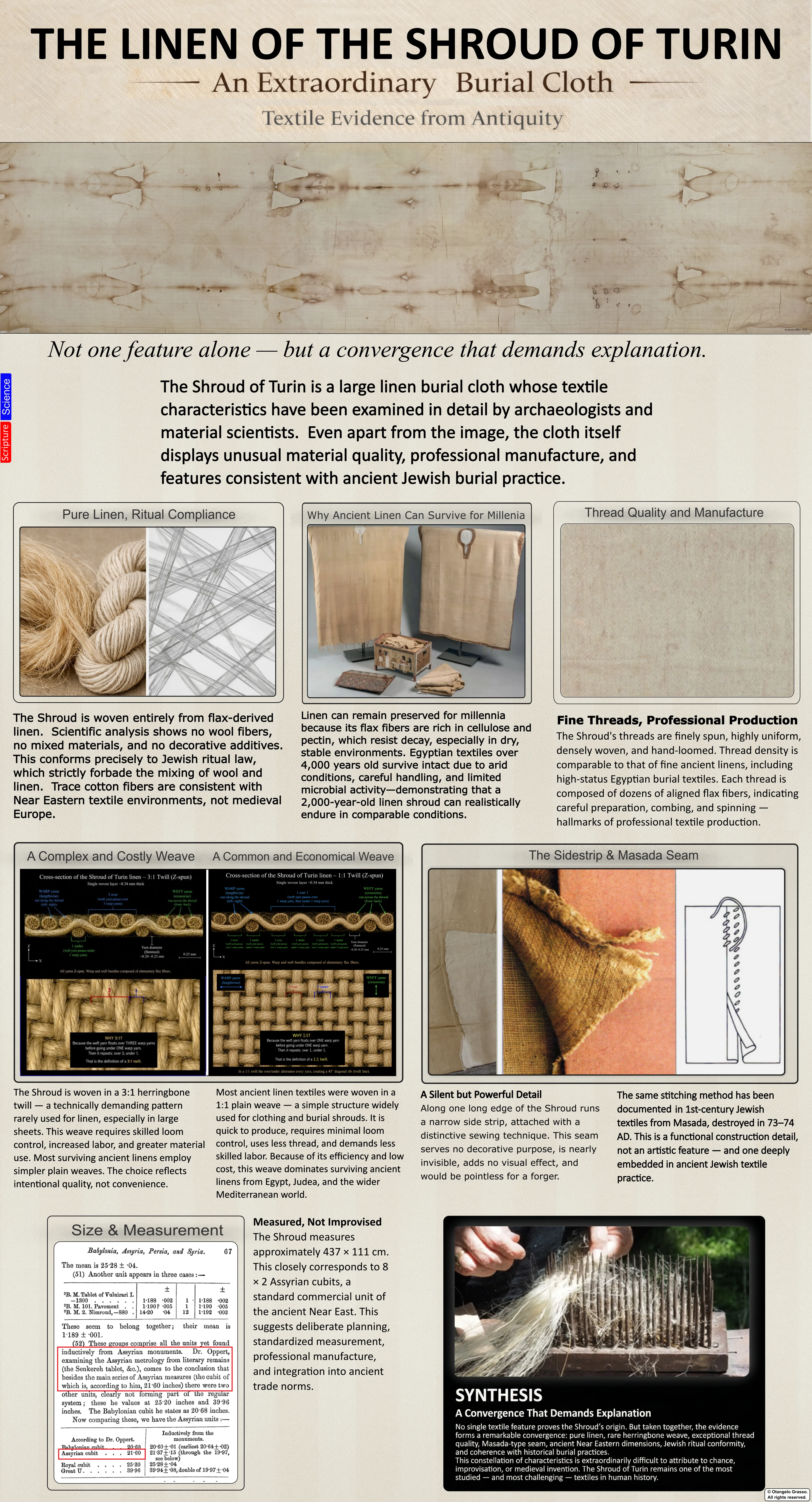
The Shroud is not only an image-bearing object. It is also a large, handwoven linen textile whose fibres, yarns, weave, seams, wear, and conservation history can be examined. Those details tell us how unusual the cloth is and what comparisons are worth making. They do not, by themselves, name its maker or settle its date.
This article follows the material evidence from the plant fibre to the finished cloth. It brings together the technical reports, archaeological comparisons, loom experiments, conservation observations, and the two supplied books. Where the books advance a hypothesis—about a Jewish workshop, an eastern trade route, a cubit-based design, bleaching, or a first-century date—the hypothesis is identified as an interpretation and weighed against the published evidence. “Observed,” “compatible with,” and “proves” are not interchangeable.
1. Start with the right questions
Several separate questions are often compressed into the phrase “the age of the linen”: What is the cloth made from? How was it woven? What tools and skills would its production require? Where do comparable textiles occur? When was the flax harvested? Does the date of the tested sample represent the entire cloth? And, separately, is this the burial cloth described in Christian tradition? Textile analysis can answer some of these questions more directly than others. It cannot establish the identity of the person whose image appears on the cloth.
For clarity, this article uses four levels of claim. A direct observation describes something measured or seen on the cloth or a documented fragment. A technical inference proposes how a feature was made. A historical comparison asks whether the feature resembles textiles from a dated context. A provenance or date claim identifies a place or period. Each step requires additional evidence. A familiar-looking stitch is not a date; a loom experiment is not an archaeological find; and a textile being possible in an era does not show that it was made then.
2. The cloth: dimensions, structure, and edge
The main textile is a long rectangular linen cloth measuring about 4.30 by 1.08 metres in the recent technical description. A narrow strip, approximately 3.80 metres by 8 centimetres, is attached along one long edge. Published dimensions vary slightly because authors measure different edges, include or exclude the strip, and account differently for the irregular or conserved margins.1, 3
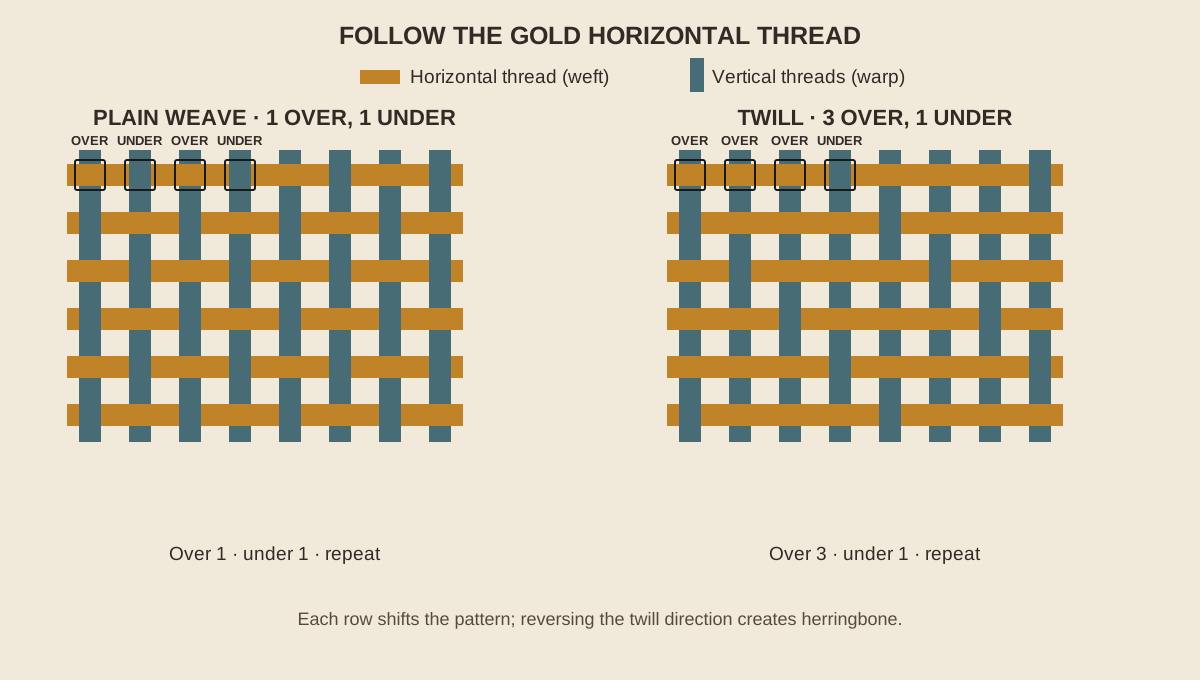
Linen is cloth made from flax fibres. The Shroud’s main fabric is reported as a 3/1 twill: each weft thread passes over three warp threads and then under one, with the interlacing point shifting across the cloth. Reversing the direction of the diagonal creates the repeated V-shaped “herringbone” or chevron. This is a description of the interlacement. The pattern is sometimes called “three-to-one herringbone,” but it should not be confused with every ancient textile called herringbone: a 2/2 diamond twill in wool, for example, is structurally different from a 3/1 linen twill.
The shape and construction record practical decisions by the weaver: the cloth’s width, the edge treatment, the joining of the strip, and the repeating pattern. Those decisions can be compared with other textiles and loom technologies. They do not carry an intrinsic calendar date. The exact dimensions are also used in the books to propose an eight-by-two cubit design. That is an interesting pattern-matching proposal, but ancient cubits varied and the cloth’s present dimensions are not perfectly regular. A chosen cubit and a close numerical fit cannot independently establish a design intention or a place of manufacture.12, 13
3. A short history of textile examination
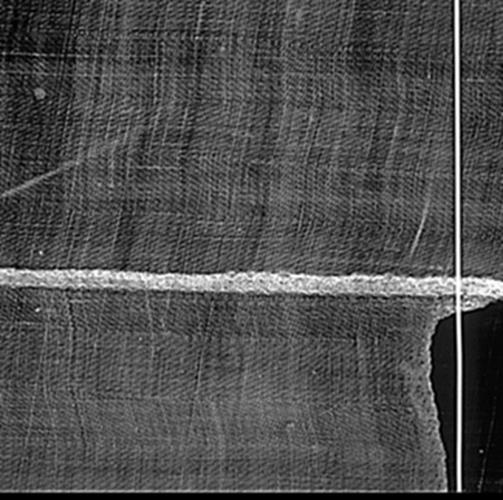
In 1969, a commission appointed in Turin examined the Shroud but did not take a textile sample for laboratory analysis. The 1973 examination by Belgian textile specialist Gilbert Raes was the first modern direct textile study with a sample. A small piece was cut from one end, including material from the seam area where the main cloth meets the attached strip. Raes described the two fabrics separately, recorded yarn counts and thickness, and reported Z-direction twist in the yarns. His observations remain important, but they derive from one small location, not a systematic map of the whole textile.1, 2
During the 1978 Shroud of Turin Research Project (STURP) examination, the cloth was photographed and studied with microscopy, spectroscopy, and other methods over several days. The project included conservation and textile expertise. Its broad documentation added context to the local Raes sample, but the team did not remove or count threads across the entire cloth. Gabriel Vial’s later technical study assembled textile observations and comparative discussion; it is a specialist report, not a new full-surface sampling campaign.2, 6
Mechthild Flury-Lemberg examined and handled the cloth during the 2002 conservation intervention, when the backing cloth was removed and the Shroud was restitched. Her account is particularly relevant to construction and the side-strip seam. Conservation examination has a different strength from a destructive laboratory test: it can document the object directly, but access, handling, image resolution, and the need to protect the cloth constrain what can be checked.7
In April 2026, Rachel Freer-Waters and A. J. Timothy Jull published a peer-reviewed analysis of two tiny fragments retained from the Arizona portion of the 1988 radiocarbon sample. Their paper describes the pieces, microscopic work, and comparison with control textiles. These fragments add a new direct observation, but their combined size is still only a few millimetres. They do not amount to a survey of the whole dated corner or of the full Shroud.3
4. Flax, fibre preparation, and yarn twist
Flax fibre comes from the stem of Linum usitatissimum. Turning the plant into linen requires several operations: harvesting and retting loosen the fibres; breaking and scutching remove woody material; hackling aligns the fibres; and spinning draws and twists them into yarn. The final cloth’s properties depend on the plant, preparation, spinner, yarn thickness, loom setup, finishing, use, and preservation. A microscopic fibre identification is therefore only one part of a textile biography.
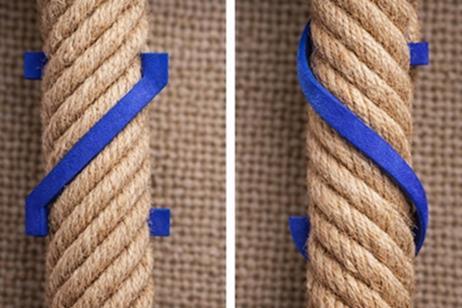
The yarns in the Shroud’s warp and weft have been described as Z-spun. “Z” and “S” name the direction of the diagonal formed by the fibres when the yarn is viewed vertically. Twist can reflect local custom or workshop practice, but it is not a geographic barcode. Many ancient Egyptian linens are S-spun, which makes the Shroud’s Z twist a useful comparison point. Yet Z-spun linen did exist in antiquity; the 2026 fragment authors note an early Egyptian example. A rare pattern is not the same as an impossible one.3, 4
Thread continuity and apparent regularity also need scale and method. Hand-spun yarn can be remarkably even, and machine-spun yarn can vary. A close photograph may make one segment seem smoother or more uniform than another because of lighting, magnification, focus, or conservation deposits. A defensible comparison needs calibrated images, consistent counting rules, measurements from multiple locations, and published uncertainty. The author’s books discuss yarn uniformity and the implications of fibre preparation; those points are best treated as observations to test rather than as a settled clock.
Likewise, the absence of identified wool in a tiny sample cannot establish that a Jewish workshop made the linen or that the cloth complied with a religious textile rule. The biblical prohibition on combining wool and linen is culturally relevant background, but the inference from “no wool seen in the sampled fibres” to “made by a Jewish weaver” skips several steps: samples are limited, workshops could specialize in linen, and absence in one analyzed location is not proof of absence throughout the object. The material observation and the historical identity claim must remain distinct.4, 12
5. What makes the 3/1 herringbone notable?
Plain weave alternates each warp and weft thread over and under its neighbour. Twill shifts the interlacement to produce diagonal ribs. In the Shroud’s reported 3/1 structure, a weft crosses over three warp threads and under one. A repeated reversal changes the diagonal direction and produces the herringbone. This requires deliberate control of the order in which warp threads are raised and lowered. It is more involved than plain weave, but complexity is not a synonym for “medieval,” nor does it prove that a cloth was expensive, sacred, or made in one named region.
The 2026 fragments provide an unusually useful check because they came from the 1988 sampling area. Freer-Waters and Jull report flax, single Z-twisted yarn, and 3/1 twill in both fragments; one (A1A) retained a visible herringbone reversal. This is consistent with descriptions of the main Shroud fabric. Their paper also notes that they could not locate a comparable linen 3/1 herringbone textile to serve as a control for the original dating exercise. That rarity is real within the comparative material they could identify, but it does not show that no such cloth was made in antiquity or the Middle Ages. Excavated textile survival and publication are incomplete, and a comparator must match in fibre, structure, date, and preservation before it can answer a precise question.3
6. The loom debate: what experiments can establish
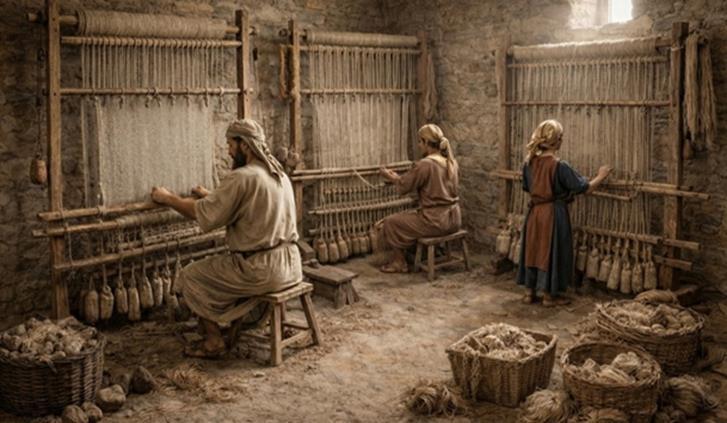
A loom controls the warp and creates a temporary opening called a shed; the weft passes through that opening. The relevant question is more specific than “Could an ancient person weave a pattern?” It is whether a particular loom configuration can make a single-layer 3/1 chevron twill at the required width and density, and whether the proposed configuration is documented in the relevant place and period.
Antoinette Merete Olsen’s 2020 experimental study attempted to set up a 3/1 chevron herringbone on a warp-weighted loom. In her arrangement, the extra shed needed for the pattern produced an additional set of warps and a double-weave effect, rather than the straightforward single-layer fabric she was trying to reproduce. The experiment is valuable because it makes the mechanical problem concrete and repeatable. It tests the specific loom and setup used; it does not prove that every ancient loom form or every possible heddle arrangement would fail.5
Antonio Nicolotti’s book makes a different technical argument from reported irregularities in the Shroud’s weave. He interprets repeated inversions or deviations in the twill as clues to “skip-threading” and to a four-harness horizontal treadle loom. If a textile’s recurring irregularities preserve the sequence used to thread the loom, that could be an important diagnostic. But an inference from an irregularity to a specific loom requires a complete, reproducible map of the affected threads, a demonstration that the proposed setup generates that pattern, and tests of alternatives such as local damage, repair, warp breakage, or observational error. The proposal deserves examination; it should not be described as proven by the published sample photographs alone.9, 13
Even a correct loom identification would not automatically yield a date. The chain of reasoning must also show when and where that loom type was in use, how securely the evidence is dated, and whether the technology was exclusive. Loom technologies and weaving knowledge travel; a technique can survive longer in one region than in another; and a rare surviving example may not represent the full historical record. At present the arguments may favour a multi-shaft or treadle-loom interpretation for some features, but the textile literature has not established that the Shroud’s structure is chronologically exclusive to fourteenth-century Europe.5, 9, 13
The cleanest way forward is to publish an image-based, thread-by-thread map and invite independent textile specialists to reproduce the proposed setup. Experiments should state the exact heddle plan, tie-up, warp tension, yarn, width, and source of each observed defect. A successful recreation would demonstrate possibility; archaeological and historical evidence would still be needed to assign a time and place.
7. Thread count, width, and workmanship
Raes reported about 38.6 warp threads and 25.7 weft threads per centimetre in the main-cloth portion of his sample. The strip material had a different yarn thickness; counts should therefore not be merged as if they were measurements of one uniform fabric. The two 2026 Arizona fragments yielded densities in the approximate ranges of 37–41 and 26–29 yarns per centimetre in the two directions, broadly consistent with the published description. Differences can arise from the exact place sampled, thread counting, conservation, compression, and the tiny area of the fragments.1, 3
A high thread count can indicate fine, skilled work. It may support the idea that the cloth was a carefully made or valuable textile. It cannot by itself tell us whether the workshop was in Jerusalem, Egypt, Syria, India, Constantinople, or medieval Europe. Nor should the Shroud be compared only with the easiest-to-find European archaeological dataset: the regions and periods most relevant to an eastern-Mediterranean hypothesis are unevenly represented among surviving textiles, and published collections differ in fibre, weave, purpose, and measurement method.
The width also matters to loom reconstruction: a loom must accommodate the warp, or the cloth must be produced in a method that joins widths. Yet “wide” is not a chronology. A useful comparison asks how wide dated textiles are, which looms produced them, whether they have selvedges or seams, and what evidence survives for the workshops. The two supplied books explore broad-loom and cubit-based reconstructions. They are valuable prompts for such comparisons, but dimensions alone do not identify a specific loom or unit of measure.12, 13
8. The attached strip and the Masada comparison
A strip approximately eight centimetres wide runs along much of one long edge. Raes’s sample included part of the join. Flury-Lemberg discussed its stitching during the 2002 conservation work and compared the seam construction with a seam or edge treatment known from textiles at Masada. The Masada fortress fell to Roman forces in 73/74 CE, giving that archaeological material a useful historical context. The comparison is often cited as evidence that the Shroud’s sewing technique was known in the first century.1, 7
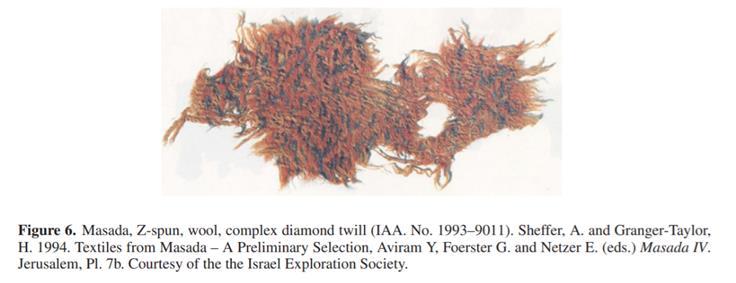
That is a narrower claim than “the Shroud seam is first-century.” A sewing method can recur, persist, or travel. The Masada material is not a matching sample of the Shroud’s linen 3/1 cloth, and resemblance of seam construction does not establish common workshop, origin, or date. To gauge the comparison’s weight, we need a detailed description of the exact stitches, their orientation and sequence, the textile edges, thread material, and an appropriate survey of dated comparators. The published comparison is a plausible historical parallel, not a direct date or an unbroken provenance link.7, 13
9. What excavated burial cloths can—and cannot—tell us
Orit Shamir’s 2015 study places the Shroud beside Roman-period textiles from the Land of Israel and discusses a first-century burial textile from Akeldama in Jerusalem. The Akeldama fabric is important because it comes from an excavated burial context in the right broad region and period. It is a wool, plain-weave textile, not linen 3/1 herringbone. Its existence documents one funerary textile and one burial practice; it does not supply a direct match for the Shroud or a complete catalogue of Jewish burial cloths.4
This comparison cuts against overstatement on both sides. The Shroud cannot be called typical first-century Judean burial linen simply because linen was used in antiquity. But the simpler surviving Akeldama textile cannot prove that every burial cloth was simple or that a wealthy household could not have used imported linen. Archaeological finds represent what survived, what was excavated, what was recognized as textile, and what has been published—not every fabric once in use.
Ancient herringbone textiles are known in multiple fibres and structures. The author’s 2026 book shows, for instance, a wool herringbone garment from South Tyrol dated broadly to the first millennium BCE. It is a useful visual reminder that patterned twill is ancient, but it is not a direct analogue for the Shroud: different fibre, different twill repeat, different garment function, and a different archaeological context. A good comparison states both the resemblance and the differences rather than making the shared word “herringbone” carry the whole argument.12
10. Long-distance trade, cotton traces, and proposed origins
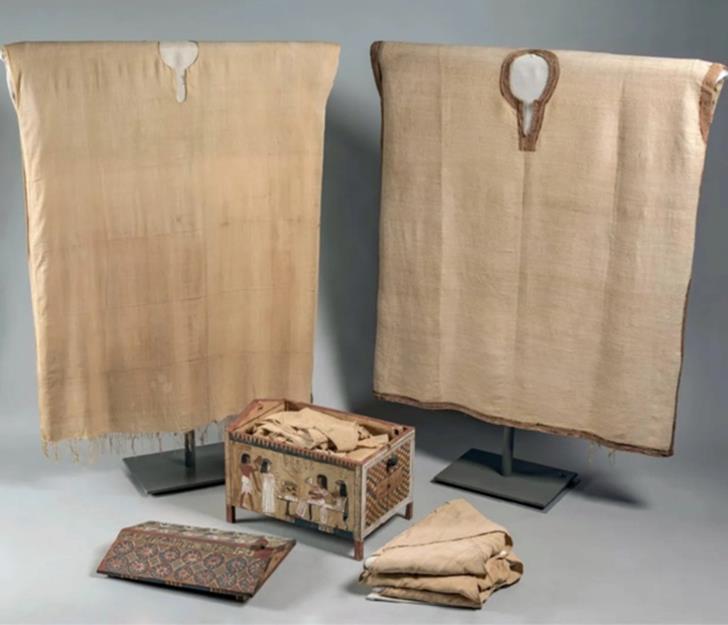
Textiles moved over long distances in the Roman period. At Berenike, a Roman port on Egypt’s Red Sea coast, excavators found first-century cotton fragments interpreted as parts of sails and related webbing. Felicity and John Peter Wild argued that much of the Z-spun cotton material was imported, probably from India. This establishes a relevant historical possibility: Indian textile materials could reach Roman Egypt. It does not show that the Shroud was made in India, that its flax came through Berenike, or that a cotton trace on another cloth identifies its origin.10
Reports of cotton fibres associated with Shroud material require particular caution. A cotton fibre can enter a linen textile during manufacture, storage, contact with another fabric, later handling, conservation, or environmental exposure. Even if a fibre’s botanical identification is secure, it does not necessarily share the linen’s date or geographic history. The provenance of the particular fragment and the route by which it was sampled matter. Cotton, DNA, pollen, and dust are not equivalent to a documented chain of custody for the flax yarns.
Carlos Barta-Gil’s 2025 historiographical review surveys proposed origins in Israel, Egypt, India, and medieval Europe. It is useful for seeing how scholars combine yarn twist, weave, fibre reports, trade routes, and historical testimony. These are distinct strands with different reliability. A broad trade network can make movement plausible; it cannot replace an archaeological match. A Z twist can be compatible with several regions; it does not select one. A proposed Indian origin needs direct comparative textiles and provenance evidence, not only the existence of Indo-Roman trade.13
11. Bleaching, banding, and finishing claims
Flax textiles could be whitened and finished using techniques available before modern chemical bleaching. The author’s books discuss natural bleaching, yarn banding, preparation before weaving, and possible consequences for the Shroud’s appearance. These questions are testable, but claims about a particular ancient recipe or sequence require evidence in the fibres and a reliable comparison set. A light/dark band in a photograph is not, on its own, proof of pre-weaving bleaching: thread variation, image processing, folds, stains, repairs, and lighting can also affect apparent tone.
A 2026 peer-reviewed study by César Barta and Elisa María Ruiz-Navas tests whether FTIR spectra can distinguish raw linen from samples treated with several assumed ancient bleaching procedures, including a natron simulation. The authors report modest spectral changes and a noticeable feature for their natron simulation, then compare the trends with the Shroud spectrum. This is a new analytical route, not a demonstrated historical recipe for the Shroud. It depends on the representativeness of the modern test samples, the exact treatment conditions, and the interpretation of a small spectral region. Its result should be described as a method under development, not as proof that the Shroud was bleached in a particular place or century.14
Any proposed textile finishing should be evaluated through blinded comparisons: prepare linen by documented ancient and later methods, age or artificially alter it under stated conditions, and compare measurements with multiple locations on the Shroud if access is permitted. This would turn the book’s observations into testable predictions. Until then, finishing details may add texture to a reconstruction, but they should not be treated as independent dating markers.
12. The difference between textile dating and textile compatibility
Textile historians often date objects through context, associated objects, inscriptions, workshop records, style, construction, fibre analysis, and comparison with securely dated finds. No single feature normally does all the work. For the Shroud, the lack of a continuous documentary history before the medieval period means that the cloth’s construction must be compared with incomplete archaeological collections, while the direct radiocarbon measurement addresses the tested fibres. Those methods answer related but different questions.
A textile may be compatible with an ancient period without being dated to it. Conversely, a feature known from a medieval find may be older than its earliest surviving example. “Earliest known” is not always “first invented.” To identify a chronological marker, the feature must be sufficiently rare, its appearance must be securely dated, and plausible earlier or later examples must be excluded. The Shroud’s Z twist, 3/1 twill, density, width, or seam is not individually an exclusive date signature in the published evidence considered here.
Raymond Rogers argued in 2005 that chemical differences between the dated-area threads available to him and samples from elsewhere indicated a reworked or non-representative patch. This paper is part of the radiocarbon controversy, but the provenance and representativeness of the small threads Rogers analyzed have themselves been questioned. His argument should be reported as a published hypothesis, not silently treated as settled fact. In 2026, Freer-Waters and Jull’s analysis of two retained Arizona fragments found them consistent with the main textile’s reported weave and twist and found no evidence of contamination in the small areas examined. The new study weakens a simple claim that the analyzed retained pieces are obviously a different fabric; it cannot resolve every question about the entire sampled corner or all subsamples used in 1988.3, 15
13. The 1988 sample and the newer fragment study
In 1988, laboratories at Oxford, Arizona, and Zurich measured radiocarbon in material taken from one corner of the Shroud. Their joint paper reported a calibrated range of 1260–1390 CE at 95% confidence. This is the most direct published calendar-age measurement of Shroud linen, but it was based on one sampling location. The published laboratory results and later-released measurement data have been statistically re-examined. Casabianca and colleagues and Di Lazzaro and colleagues report heterogeneity and raise questions about combining the subsamples into one estimate. Their conclusions are statistical critiques, not a new date: they do not demonstrate a first-century origin or quantify a contamination effect large enough to move the sample by more than a millennium. Other researchers dispute whether the reported variation invalidates the overall result. The disagreement concerns the strength of inference from the sampling and data, and should be presented as such.11, 16, 19
Two broad objections should be separated. First, some researchers argue that the dated corner may not represent the whole cloth because of repair, contamination, or uneven carbon. Second, critics of those objections point out that evidence for a patch or specific contaminant must be demonstrated with secure sample provenance and reproducible measurements. Ordinary addition of younger carbon can shift an apparent radiocarbon age, but any proposed mass-balance calculation must state what contaminant is assumed and in what proportion. A model for added carbon does not automatically explain every possible chemical or nuclear mechanism.
The 2026 paper is directly relevant because it examines retained pieces from the Arizona sample. The authors identify flax fibres, Z-spun yarns, and 3/1 twill consistent with the Shroud; fragment A1A preserves a herringbone reversal. They report no visible repair in the fragments and no significant contamination in the tiny surface field examined by microscopy. Their conclusion supports the identity of those two fragments as consistent with the Shroud’s main cloth. The authors also emphasize the small size and limited representativeness. Their paper does not re-date the fragments, recalculate the 1988 result, or map the full sampling region.3
That is a meaningful update rather than a final resolution. It increases the amount of direct textile information about retained Arizona material and makes it harder to assert that those examined fragments are visibly a different cloth. It leaves open the broader question of how the corner sample relates to the whole textile and whether new geographically distributed samples would produce a more reliable date. A future sampling plan would need conservation approval, documented chain of custody, preregistered locations, and independent laboratories.
14. The proposed X-ray scattering date
In 2022, Liberato De Caro and co-authors applied wide-angle X-ray scattering (WAXS) to a Shroud linen thread about 0.5 by 1 millimetre, taken near the 1988 sampling corner. They compared cellulose structural measurements with a small calibration set of linen samples, including one associated with the siege of Masada. Their paper reported that the Shroud thread’s measured profile was compatible with the Masada sample and inferred an age much older than the radiocarbon result under specified long-term temperature and humidity assumptions.17
This is a preliminary method proposal, not an independent accepted date with the same validation history as accelerator mass spectrometry. It analyzes one tiny sample; the calibration set is limited; and cellulose degradation depends on long-term environmental history, heat, moisture, fire, handling, and storage. The authors themselves discuss assumptions about the Shroud’s historical temperature and relative humidity. The WAXS result is therefore worth reporting as a published, discordant measurement, while its small sample base and environmental model must remain visible. It cannot simply be used as a replacement date for the 1988 test.
15. What the linen evidence supports
The material observations are substantial: the Shroud is a large linen textile; the main fabric has been described as a 3/1 herringbone twill; the yarns are reported as Z-twisted; measured thread densities are relatively fine; a long side strip is joined to the main cloth; and the tiny retained Arizona fragments examined in 2026 are consistent with these reported features. The textile is technically distinctive and the surviving comparators are imperfect.
The interpretations are more limited. The weave and twist can be compared with ancient and medieval practice, but neither is a unique date stamp. The Masada seam is a potentially relevant construction comparison, not a demonstrated match in fibre or cloth. Indo-Roman trade shows that long-distance movement of textile materials was possible, not that this cloth came from India. Loom experiments illuminate technical possibilities, but their historical dating implications require independent evidence. The 1988 radiocarbon result remains the strongest direct chronology for the tested material; its sampling representativeness and statistical treatment remain subjects of published debate. The 2022 WAXS study provides an interesting but limited alternative estimate. None of these facts identifies the image-bearing cloth with a particular person.
The balanced conclusion is neither that the textile proves a first-century origin nor that its construction alone proves medieval manufacture. Its fabric is compatible with a sophisticated workshop, and several proposed ancient contexts merit further comparison; the direct dating evidence and the limits of the available textile record must be addressed at the same time. The linen evidence narrows and clarifies the questions. It does not settle the whole historical case.
16. What a stronger examination would look like
A useful next programme would begin with non-invasive documentation: high-resolution images of the full weave at calibrated scale; a georeferenced map of yarn direction, density, selvedges, seams, repairs, and irregularities; and standardized records of every location. Textile specialists should independently score the images before being told which interpretation is being tested. Loom experiments could then reproduce proposed irregularities with several heddle and tension arrangements, publishing the setup and failures as well as successful examples.
Comparative work should include securely dated textiles from Egypt, the Levant, the broader Byzantine world, Roman ports, medieval Europe, and South Asia. Comparisons need to record fibre, twist, weave repeat, yarn count, selvedge, seam, finishing, and archaeological context—not merely use broad labels such as “linen,” “herringbone,” or “ancient.” If future radiocarbon sampling is ever permitted, multiple locations and independent laboratories would be more informative than a single corner, but conservation and chain-of-custody requirements come first.
These steps would make the competing proposals falsifiable. If a feature is truly specific to a loom, reproducible experiments should identify it. If a finishing treatment is proposed, blind spectral tests should distinguish it from alternatives. If a sample is said to be atypical, a mapped comparison should show where and how. That is how the rich material in the books and research papers can guide further work without making the evidence claim more than it can support.
References and further reading
- Gilbert Raes, “The Textile Study of 1973–1974,” Shroud Spectrum International 38/39 (1991), pp. 3–6. Early direct examination and measurements of the 1973 sample. [Read the report].
- Gabriel Vial, “The Shroud of Turin: A Technical Study,” Bulletin du Centre International d’Étude des Textiles Anciens 67 (1989), pp. 11–24. Textile analysis and comparative discussion. [English translation].
- Rachel Freer-Waters and A. J. Timothy Jull, “Analysis of textile fragments from the 1988 radiocarbon samples of the Turin Shroud,” npj Heritage Science 14, article 263 (2026). [Open-access article].
- Orit Shamir, “A burial textile from the first century CE in Jerusalem compared to Roman textiles in the Land of Israel and the Turin Shroud,” SHS Web of Conferences 15 (2015), 00010. [Article and DOI].
- Antoinette Merete Olsen, “The Shroud of Turin and the Extra Sheds of Warping Threads: How Hard Can It Be to Set up a 3/1 Chevron Twill, Herringbone on a Warp-weighted Loom?” EXARC Journal 2020/4. Experimental weaving study. [Read the article].
- Louis A. Schwalbe and Raymond N. Rogers, “Physics and Chemistry of the Shroud of Turin: A Summary of the 1978 Investigation,” Analytica Chimica Acta 135 (1982), pp. 3–49. [Journal record].
- Mechthild Flury-Lemberg, Sindone 2002: L’intervento conservativo – Preservation – Konservierung (Editrice ODPF, 2003). Conservation account and discussion of the side-strip seam and Masada comparison.
- Ioannis Karapanagiotis, “The Shroud of Turin: An Overview of the Archaeological Scientific Studies,” Textiles 5, no. 1 (2025), article 8. Overview of the limits imposed by restricted access and small sample availability. [Open-access review].
- Antonio Nicolotti, La Sindone di Torino in quanto tessuto: analisi storica, tecnica, comparativa (2018). Textile-historical argument concerning weave defects and loom type.
- Felicity C. Wild and John Peter Wild, “Sails from the Roman Port at Berenike, Egypt,” International Journal of Nautical Archaeology 30, no. 2 (2001), pp. 211–220. [DOI and abstract].
- P. E. Damon et al., “Radiocarbon Dating of the Shroud of Turin,” Nature 337 (1989), pp. 611–615. [DOI].
- Otangelo Grasso, The Shroud of Turin: A Forensic Summary of the Evidence, 3rd ed., chapter “The Weaver’s Fingerprint”; and From Forensics to Faith (2026), section on linen. The supplied books’ measurements, images, comparisons, and hypotheses are cited here as the author’s work, while their evidential status is assessed against specialist sources. [Find Forensic Summary on Amazon] · [Find From Forensics to Faith on Amazon].
- Carlos Barta-Gil, “Cuestiones historiográficas sobre la procedencia del tejido de la Síndone de Turín,” Cuadernos de Arqueología de la Universidad de Navarra 33 (2025), pp. 187–212. [DOI].
- César Barta and Elisa María Ruiz-Navas, “Bleaching of historical old linen fabrics: the case of the Shroud of Turin,” npj Heritage Science (published 24 September 2026; accepted article version). Experimental FTIR comparison of linen bleaching treatments. [Article and DOI].
- Raymond N. Rogers, “Studies on the radiocarbon sample from the Shroud of Turin,” Thermochimica Acta 425 (2005), pp. 189–194. Published chemical argument that the sampled area was not representative; sample provenance and interpretation remain debated. [DOI].
- Paolo Di Lazzaro, Anthony C. Atkinson, Paola Iacomussi, Marco Riani, Marco Ricci, and Peter Wadhams, “Statistical and Proactive Analysis of an Inter-Laboratory Comparison: The Radiocarbon Dating of the Shroud of Turin,” Entropy 22, no. 9 (2020), article 926. Statistical critique arguing for heterogeneity in the reported measurements; its interpretation is contested and does not itself establish an alternative calendar date. [Open-access article].
- Liberato De Caro et al., “X-ray Dating of a Turin Shroud’s Linen Sample,” Heritage 5, no. 2 (2022), pp. 860–870. WAXS analysis of a tiny thread near the radiocarbon sampling area, with conclusions dependent on calibration and environmental assumptions. [Open-access article].
- Otangelo Grasso, “The Linen of the Turin Shroud: A Critical Assessment of the Textile Evidence” (2026). Author’s extended critical review of the linen, dating, loom controversy, archaeological comparisons, and testable next steps. [Download the full article PDF].
- Tristan Casabianca, Emanuela Marinelli, Giuseppe Pernagallo, and Benedetto Torrisi, “Radiocarbon Dating of the Turin Shroud: New Evidence from Raw Data,” Archaeometry 61 (2019), pp. 1223–1231. The authors argue that released raw data show heterogeneity and call for reconsidering the statistical procedure; this is a critique, not an alternative calendar date. [DOI].
The relevant papers supplied for this project are also catalogued in the textile research collection and PDF article index.